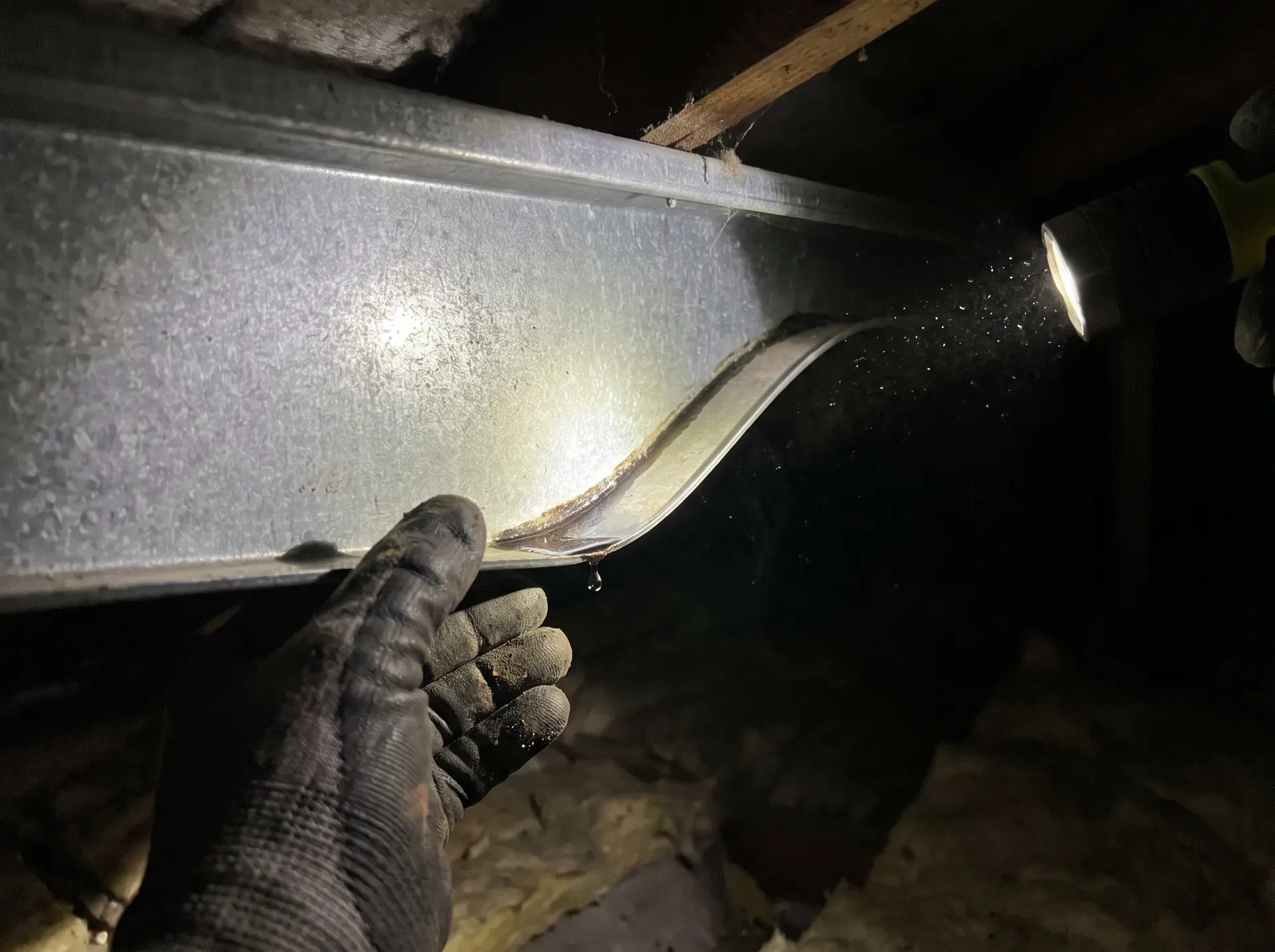
Metal Roof Leak Repair
Water shows up on a ceiling a long way from where it got in. We work backwards from the stain to the real entry point, repair that detail, and leave the twenty other places somebody would have sealed alone.
See how we fix it
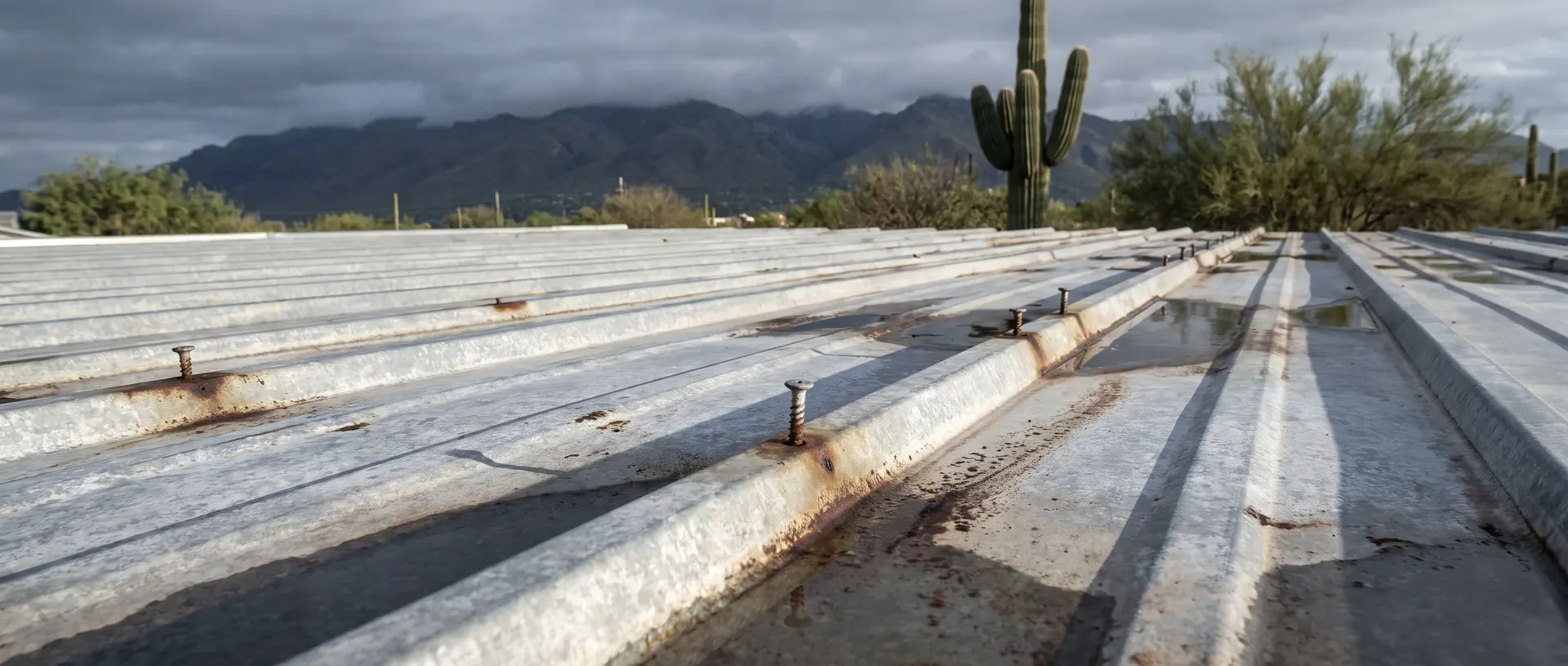
An exposed fastener roof is held down and sealed by several hundred rubber washers. In this climate they wear out well before the panels do.
An exposed fastener metal roof is a straightforward, honest piece of engineering. Panels are screwed down through their face, and each screw carries a bonded washer that squashes slightly under the head and makes the seal. It works extremely well.
What it depends on is the washer, and in Tucson the washer is up against the worst combination there is. Direct ultraviolet all day. Surface temperatures that climb enormously by afternoon and drop away at night, so the panel expands and contracts along its whole length every day of its life. That movement is real force, and it works against every screw in the roof, all the time.
Eventually the rubber goes hard, cracks and squeezes out sideways from under the head. The screw itself starts to walk backwards, or spins in a hole that has widened. Now you have a hole in the roof rather than a fastener in the roof, and there are hundreds of them at the same age doing the same thing.
This is the most predictable failure on a Tucson metal roof, and it is a maintenance job rather than a disaster. Done at the right time it is straightforward. Left too long, the screw holes elongate and it stops being a fastener job and becomes a panel job.
The seal is gone but the screw looks fine from the ground. The rubber has gone hard, split, and spread out from under the head into a flat ring. Water now runs straight down the shank and through the panel. This is the majority of what we find and it is invisible without getting on the roof.
Thermal movement has walked them up out of the purlin. You can often see these from the driveway as a line of heads sitting proud of the surface, each throwing its own small shadow in low sun. They are no longer clamping anything and no longer sealing anything.
The screw spins without biting, or the hole has worked into an oval slot under wind loading. A standard replacement screw will not fix either. These need an oversize fastener into sound material, and where the panel itself has torn, a repair to the panel first.
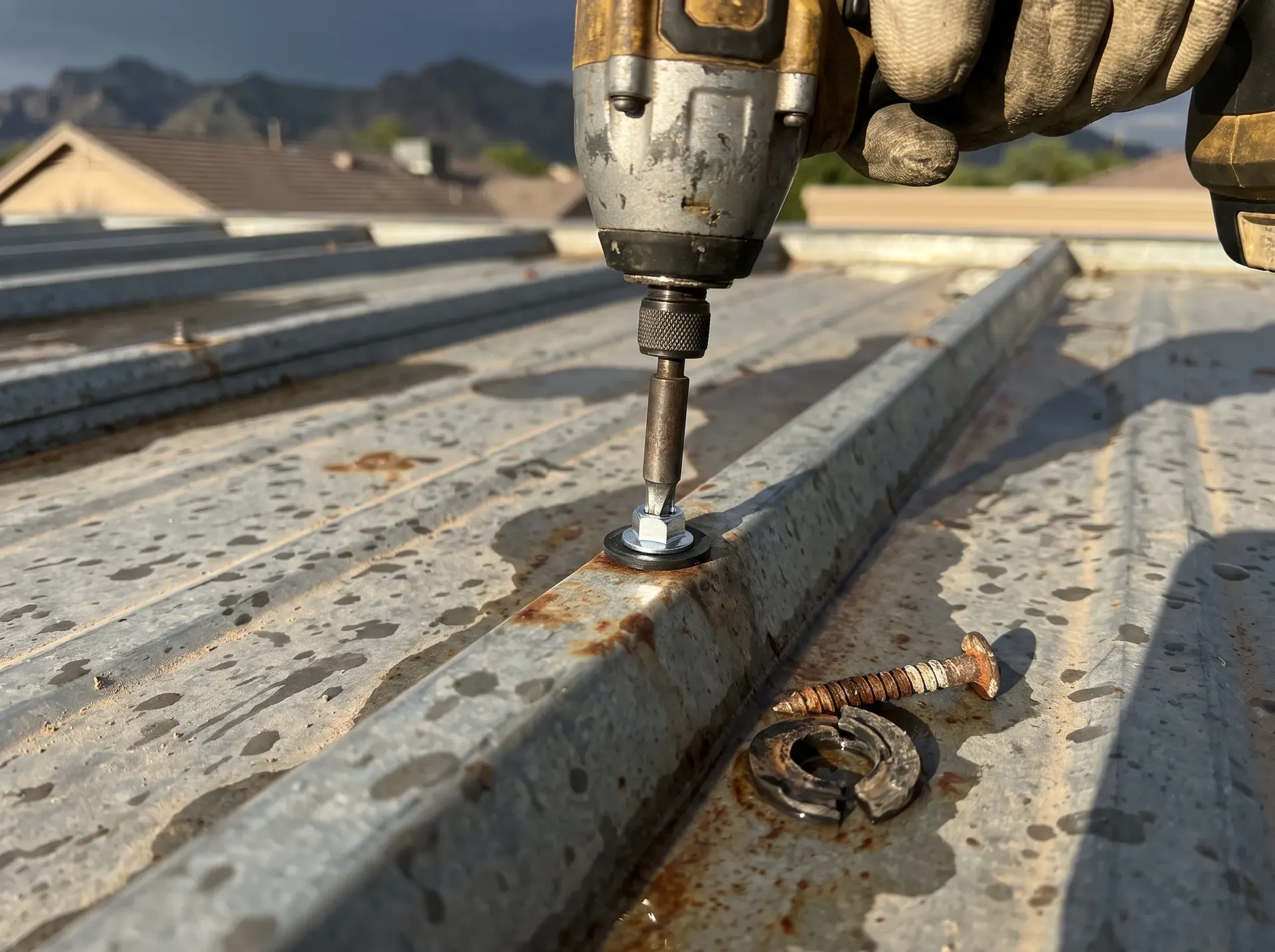
If nothing has been touched since it went on and it is over fifteen, we already know roughly what we are going to find.
Proud heads, perished washers, rust haloes around the holes and any hole that has elongated. This is a survey, not a spot check.
A handful of failures is a repair. A roof where the washers have reached the end together is a whole field job, and doing it in patches means coming back annually.
No point putting a perfect fastener into a purlin that has been damp for six years.
Consistently. The commonest bad job in this trade is a roof full of screws driven by feel, half of them crushed and half of them loose.
What we replaced, what we left because it was still sound, and roughly when the rest is likely to want attention.
Coming back every year to chase individual screws across the same roof is a service somebody could sell you indefinitely. When the washers have gone as a batch, doing them as a batch is the cheaper answer and we will say so.
The washer needs to compress and no more. Crushed washers fail immediately, loose ones never sealed at all, and you cannot tell either from the ground. This is the whole job and it is the part most often done carelessly.
A hole worked into a slot, or a purlin that has been wet for years, will not be fixed by a bigger screw. We would rather repair the panel or the substrate properly than sell you a fastener that pulls out next August.
A fastener job on a sound roof is not an emergency and should not be sold as one. It is the single most effective thing you can do to a fifteen year old exposed fastener roof in this climate, and it is best done before monsoon season rather than during it.
Whatever the detail that failed, the two jobs below are where most of this work actually lands. If the description above did not quite match your roof, start with one of them.
Water shows up on a ceiling a long way from where it got in. We work backwards from the stain to the real entry point, repair that detail, and leave the twenty other places somebody would have sealed alone.
See how we fix it
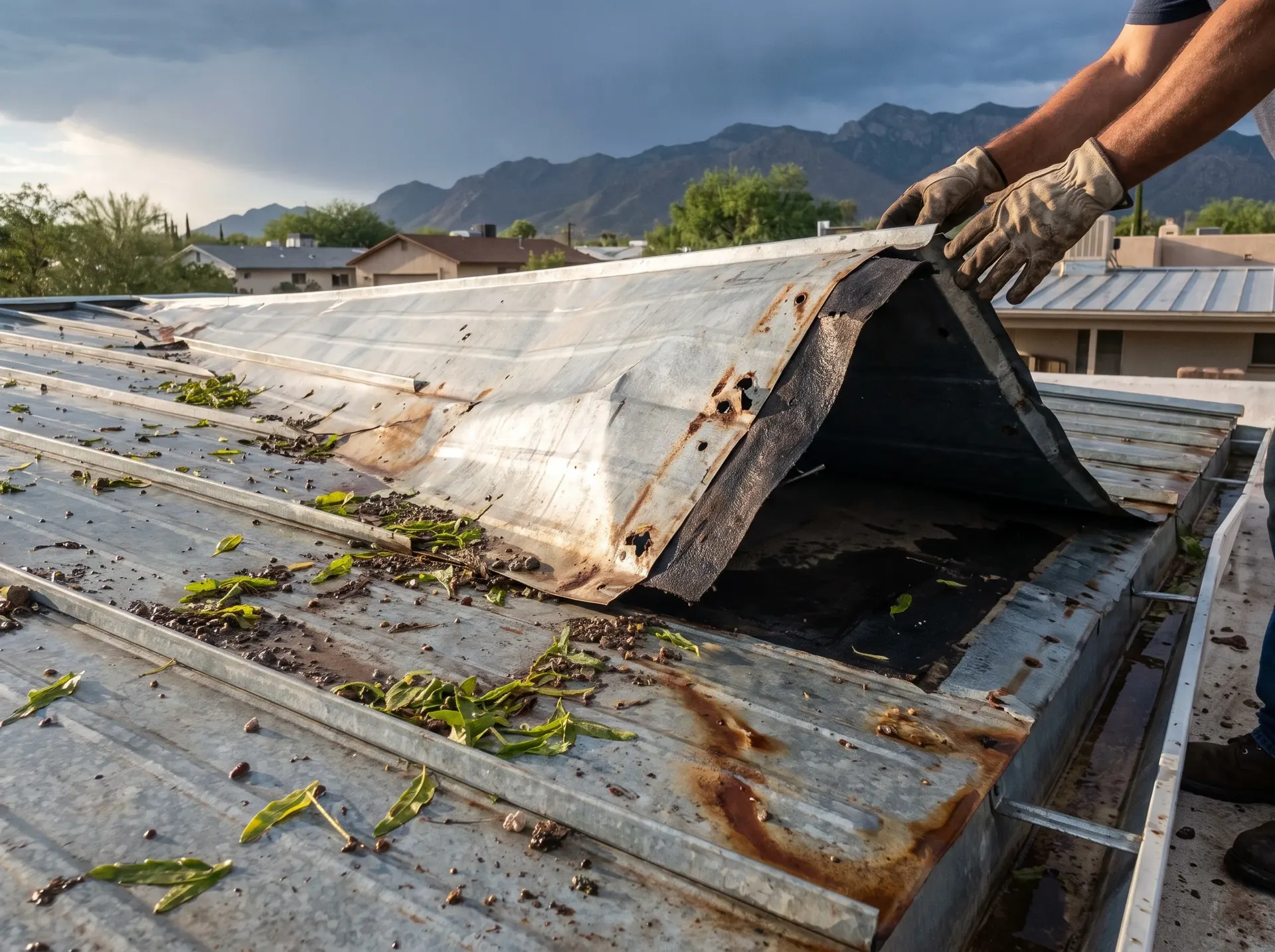
Lifted panel edges, fastener holes torn into slots by wind loading, driven rain forced under laps, and hail bruising out toward the Rincons. Storms break some things and simply expose others.
See how we fix it
If you can see them from the ground, they have been that way a while. Tell us roughly how old the roof is and we will tell you what usually comes next.
We have not collected any reviews yet. When we do they will appear here in full, in the customer's own words.
Thermal movement. The panel expands as it heats through the day and contracts as it cools at night, and it does that along its whole length. That movement works against every fastener continuously. Over years it walks screws up out of the purlin, particularly on long panel runs and on the slopes that take the most sun. In this climate it is normal ageing rather than a defect.
Exposed fastener roofs do, in time, and it is the most predictable leak there is on one. The seal is the rubber washer, not the screw, and heat and ultraviolet destroy rubber. Once the washer has hardened and split, every fastener is an open hole in the roof. Standing seam and concealed fastener roofs avoid this by not putting screws through the face of the panel at all.
There is no fixed interval, and anyone offering one without looking at the roof is guessing. What matters is the condition of the washers, which depends on sun exposure, panel length, colour and how well they were driven originally. Practically, an exposed fastener roof in Tucson is worth inspecting once it is into its second decade, and many need the field done somewhere around then.
Through the flat, into the purlin, on almost all modern exposed fastener panels. That is where the panel is supported, so the washer can compress against something solid. Screwing through the ridge leaves the fastener spanning air, which deforms the panel and gives the washer nothing to seal against. Older systems and some corrugated profiles did it differently, which is why matching what is there matters.
You cannot stop thermal movement, so the answer is a fastener that tolerates it: correct length so it gets full engagement in sound material, correct diameter, a quality bonded washer, and driven to the right depth rather than as tight as the driver will go. Where a hole has already elongated, an oversize screw into fresh material is what holds. Re driving the same screw into the same worn hole does not.
It depends on the size of the roof, the number of fasteners, access, and how many holes have elongated to the point of needing more than a screw. What we can say is that a full field replacement on a sound roof is a maintenance cost and a replacement is a capital one, and the gap between them is very large. You get a figure after somebody has actually been on the roof and counted, not before.
Anywhere else in Pima County, call and ask.
Something went wrong sending that. Please call (520) 555-0132.
We have your details. If you said water is coming in right now, that goes ahead of scheduled work. Otherwise expect a call back during opening hours.