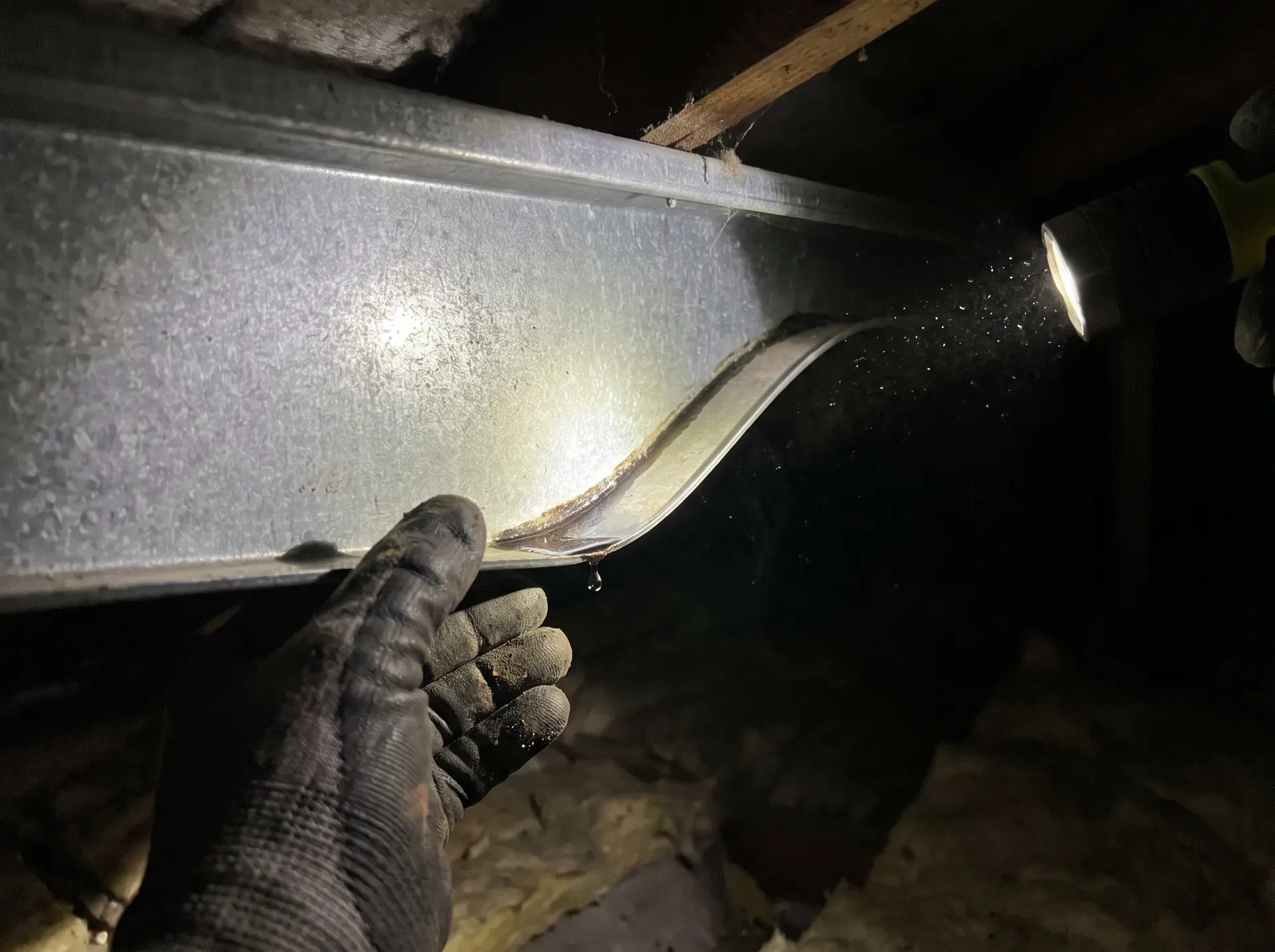
Metal Roof Leak Repair
Water shows up on a ceiling a long way from where it got in. We work backwards from the stain to the real entry point, repair that detail, and leave the twenty other places somebody would have sealed alone.
See how we fix it
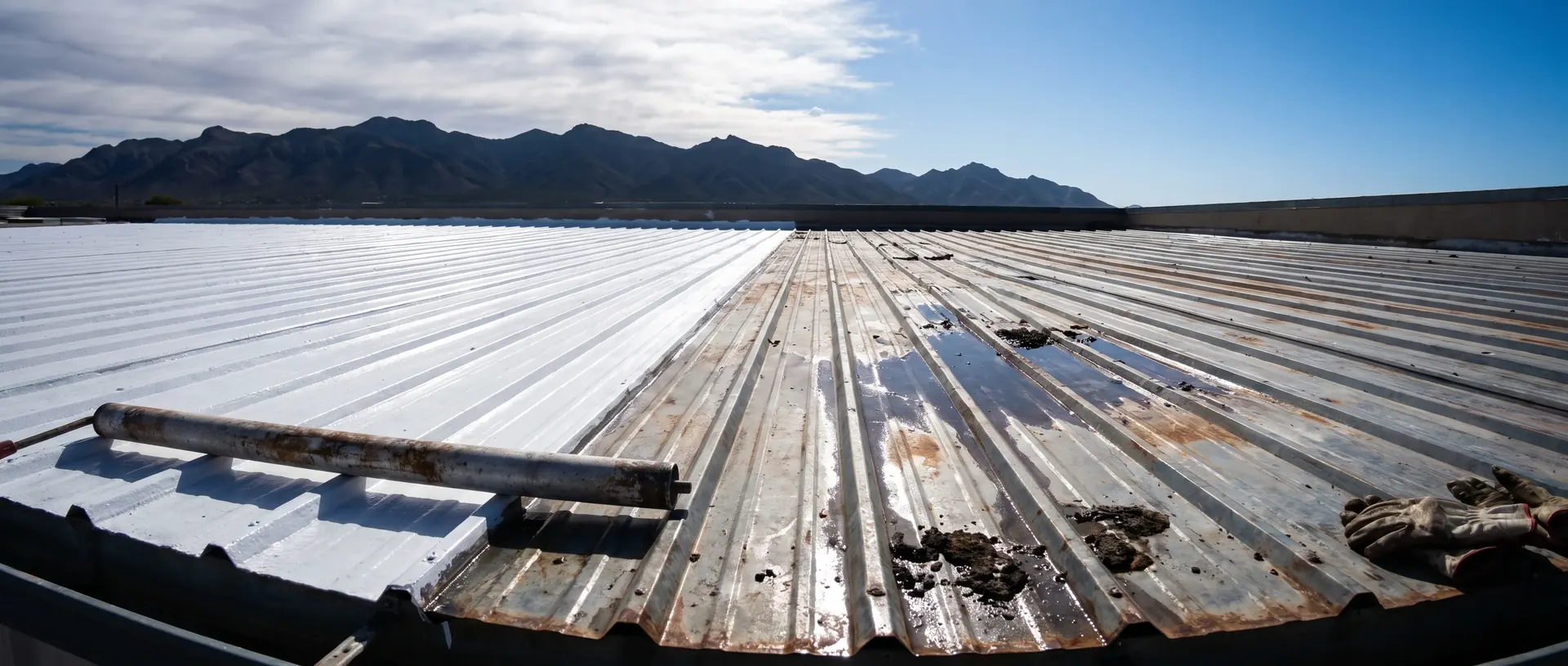
For the roof that is not failing in one place. It is tired everywhere at once, and a restoration coating deals with all of it in a single pass.
Most of what we do is find one failure and repair it. Coating is the other kind of job. It is for a roof where nothing in particular has broken, but the coating has chalked away to a dull grey, the sealant at every lap has gone hard, the fastener washers are all the same age, and the whole surface is running hot enough to keep doing damage.
Repairing that one detail at a time is possible and it is not sensible. There are hundreds of details and they are all at the same point in their life. A restoration coating addresses the entire surface in one operation: every lap, every seam, every fastener head and every square foot of chalked panel gets a new continuous membrane over the top.
The second thing it does matters specifically here. A bare or faded metal roof in Tucson gets extremely hot in summer, and that heat is what drives the thermal movement working the fasteners loose and tearing the sealant in the first place. A reflective coating brings that surface temperature down. It does not stop thermal cycling, but it reduces the range the panel swings through, which takes load off every fastener on the roof.
It is not a universal answer. Coating a roof that is already perforating, or one with wet insulation trapped underneath, seals in a problem rather than solving it. The assessment matters more than the product.
Chalked, faded, hard sealant at every joint, minor surface corrosion at the cut edges, and no single failure worth calling out. This is the roof coating exists for, and it is extremely common at the fifteen to twenty five year mark here.
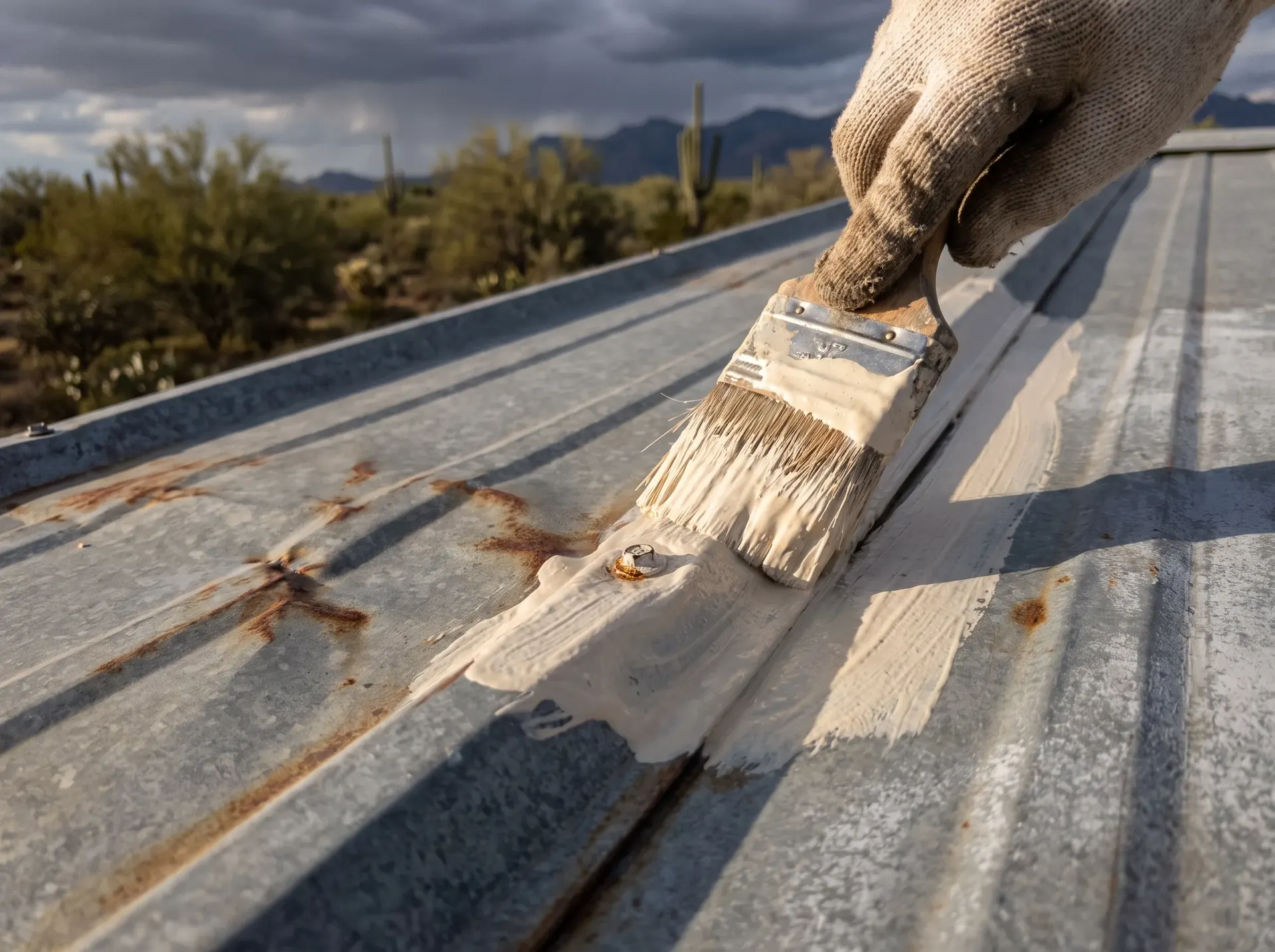
Rather than treating each one individually, the coating bridges every fastener head and every lap in one continuous layer. On an exposed fastener roof this is often the practical alternative to a full field re fastening, and sometimes it is done alongside one.
A dark or faded panel in a Tucson July gets very hot, and the daily expansion and contraction that follows is what loosens fasteners and tears sealant. Reflecting more of that heat reduces the movement the roof lives through every day.
This is a real question with a real chance of a no. A roof that has started to perforate needs metal, not membrane.
Wet or compressed insulation, or decking that has been damp for years, has to be found before anything is sealed over it.
Boots, flashing, torn fastener holes, open laps and any corrosion back to sound metal. The coating goes over a roof that is already watertight.
Cleaned, chalk and loose material removed, bare metal treated. This is the step that decides whether the system lasts or lifts.
Primer where required, reinforcement at every seam, lap and fastener head, topcoat at the correct thickness. Thin coverage over a joint is where early failures start.
Coatings are a renewable surface rather than a permanent one, and knowing when to look at it again is part of the job.
It is an easy product to sell to somebody who has been quoted for a replacement, because it sounds like a bargain. On a roof that is already perforating it is money spent to delay the same conversation by a season, and we would rather say so.
A coating applied over a failed pipe boot leaks through the coating. The membrane is a surface, not a repair, and treating it as a repair is the most common way these jobs go wrong.
Most coating failures start at a joint that was rolled over at the same thickness as the flat panel. Those points move more and take more stress, and they need reinforcing rather than covering.
A reflective coating brings surface temperature down and that genuinely reduces the daily movement ageing your roof. What we will not do is quote you a percentage saving on your cooling bill, because that number depends on your building, not on our product.
Whatever the detail that failed, the two jobs below are where most of this work actually lands. If the description above did not quite match your roof, start with one of them.
Water shows up on a ceiling a long way from where it got in. We work backwards from the stain to the real entry point, repair that detail, and leave the twenty other places somebody would have sealed alone.
See how we fix it
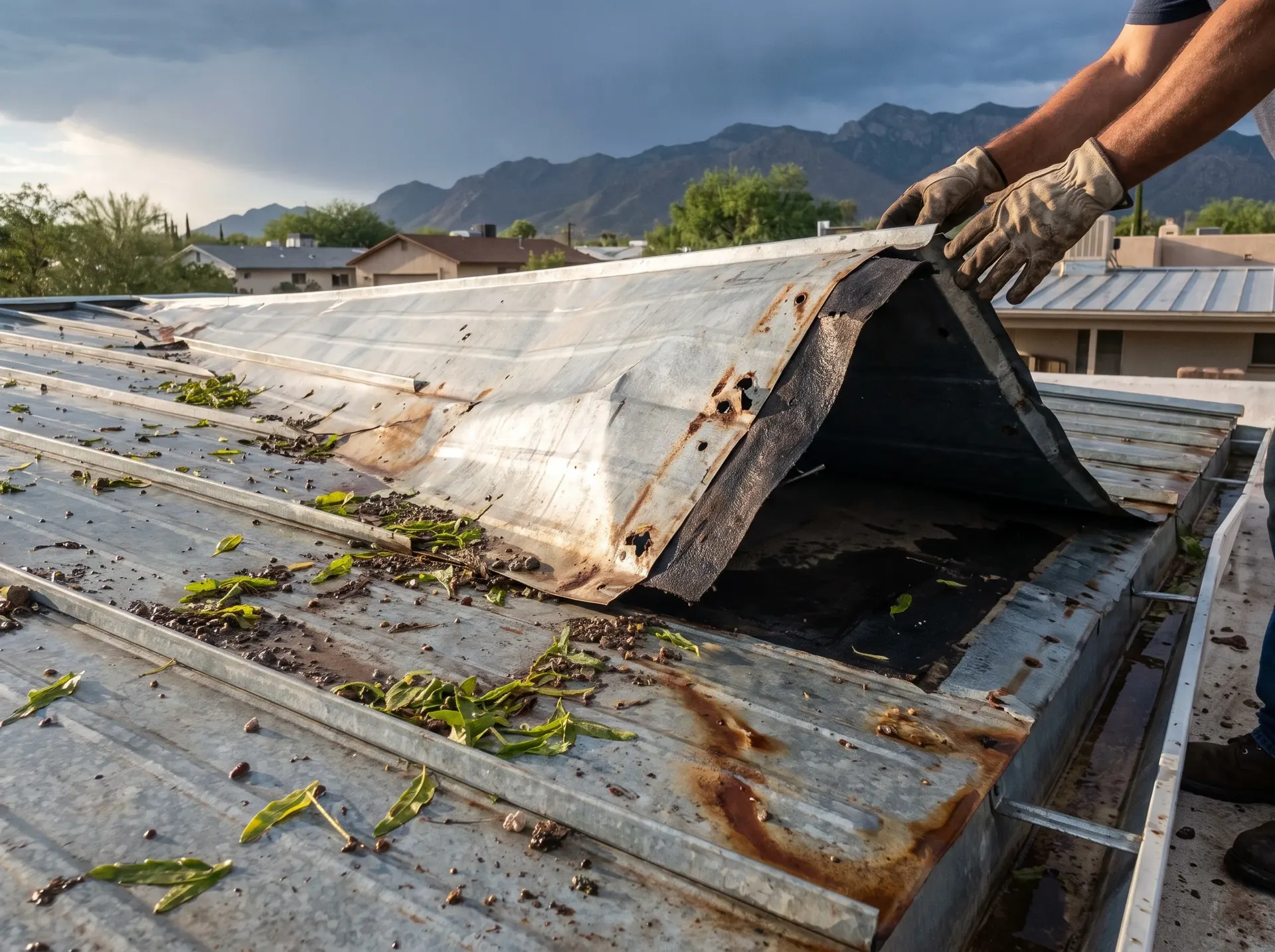
Lifted panel edges, fastener holes torn into slots by wind loading, driven rain forced under laps, and hail bruising out toward the Rincons. Storms break some things and simply expose others.
See how we fix it
That is usually a coating conversation rather than a replacement one. Tell us how old it is and whether it is leaking anywhere.
We have not collected any reviews yet. When we do they will appear here in full, in the customer's own words.
Coating is dramatically less expensive than replacement, which is exactly why the important question is whether the roof is a candidate. On sound panels it is a genuine alternative that adds years. On panels that have started to perforate it is money spent to postpone a replacement rather than avoid one. The assessment is what determines which of those you are buying.
Yes, and coating is one of the ways, though it addresses a different problem from a spot repair. A repair fixes a specific failure. A coating deals with a whole surface that has aged uniformly, sealing every lap and fastener head at once. Roofs frequently need both, with the repairs done first and the coating over the top.
Lighter colours generally hold up better in this climate, for two reasons. They run cooler, so the panel goes through a smaller daily expansion and contraction cycle and puts less load on every fastener. And fading is far less visible on a light colour than on a dark one, so the roof stays looking acceptable for longer even as the coating chalks. This is also why most restoration coatings are white or near white.
Longer than most people assume, and highly dependent on maintenance rather than age. The steel itself can last a very long time. What has a shorter life is everything around it: the fastener washers, the sealant at the laps, the boots at the penetrations and the coating on the surface. Roofs that get those attended to keep going. Roofs that never do get replaced while the panels are still sound.
That is an installation question rather than a repair one, and it is not work we do. What is relevant here is that if you already have a metal roof, the comparison that matters is between maintaining it and replacing it, not between materials. A sound metal roof that has been neglected is usually far cheaper to restore than to swap for anything else.
Decades, when the details are maintained. The panel is rarely the limiting factor. What ends most metal roofs early is an accumulation of small unattended failures, fasteners, boots and sealant, that eventually let enough water in for long enough that the structure underneath becomes the problem. At that point the roof gets replaced, and the panels are usually still fine.
Anywhere else in Pima County, call and ask.
Something went wrong sending that. Please call (520) 555-0132.
We have your details. If you said water is coming in right now, that goes ahead of scheduled work. Otherwise expect a call back during opening hours.