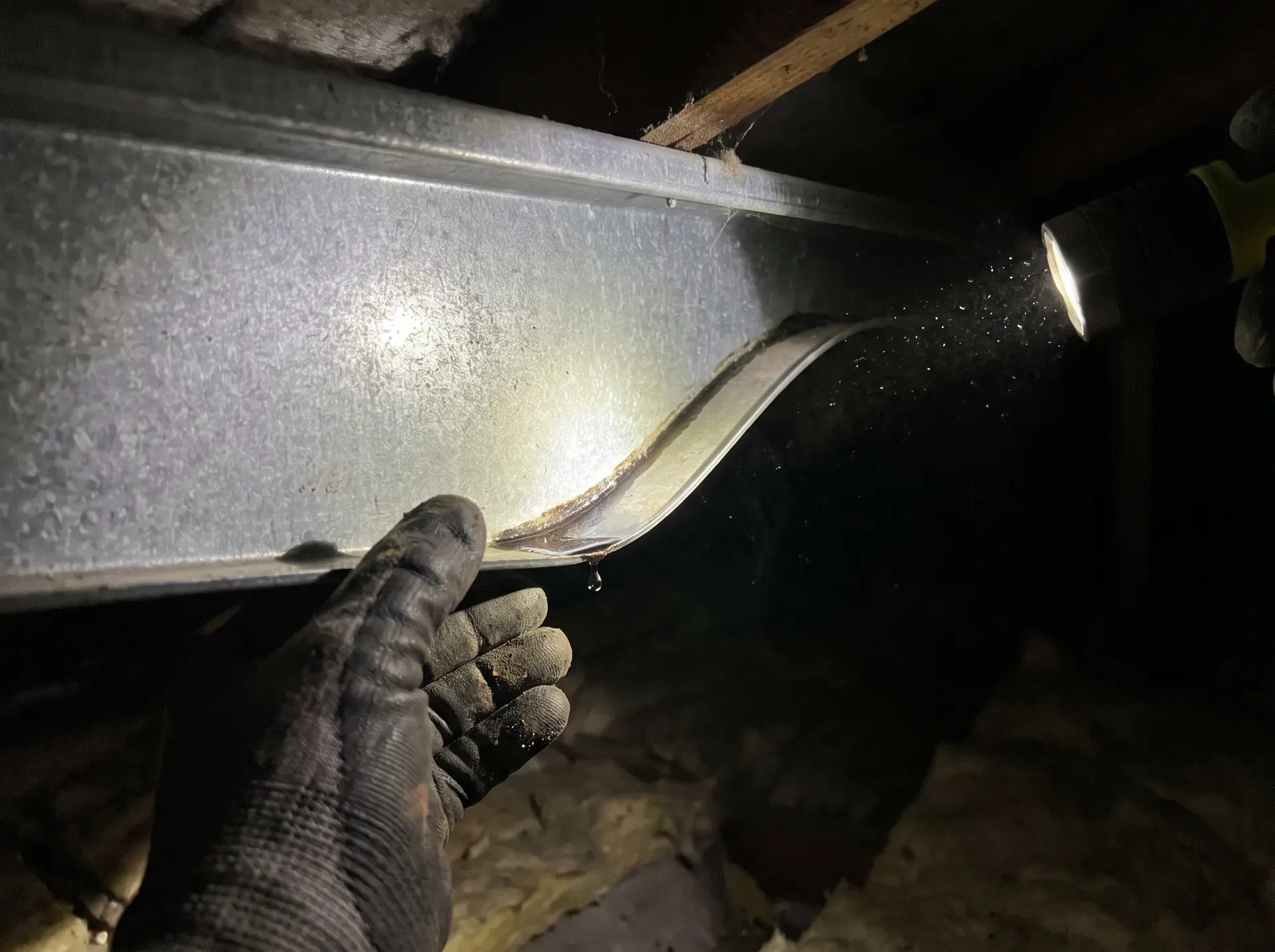
Metal Roof Leak Repair
Water shows up on a ceiling a long way from where it got in. We work backwards from the stain to the real entry point, repair that detail, and leave the twenty other places somebody would have sealed alone.
See how we fix it
A metal panel is very good at being a roof. It is every hole somebody cut through it, and the detail wrapped around that hole, that lets water in.
If you take a hundred metal roof leaks in Tucson and sort them by cause, penetrations and flashing come out on top by a wide margin. Fasteners are second. Seams and laps are third. The middle of an undamaged panel barely registers, which is why a roof that looks alarming from the ground can be completely watertight and a roof that looks immaculate can be running water into the ceiling.
The reason is simple. A panel is one continuous piece of formed metal designed to shed water. Every penetration is a hole cut through that, sealed by a secondary detail: a rubber boot, a formed curb, a piece of counterflashing tucked into a stucco wall, a bead of sealant. Those details are made of materials with much shorter lives than the steel, and they are the parts nobody looks at.
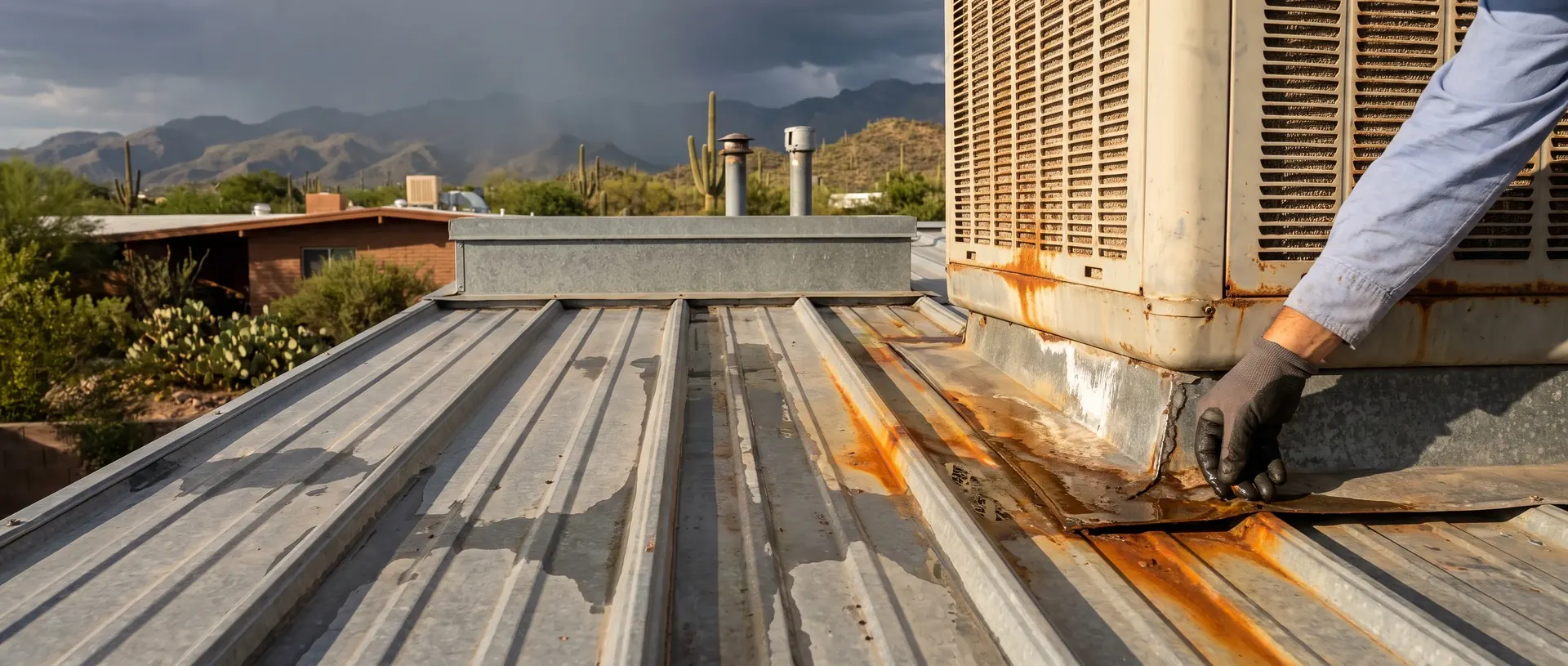
Tucson adds one detail most metros do not have. A very large share of older houses here have a swamp cooler sitting on the roof, and the curb it sits on is one of the most reliable leak sources in the city. It has a large perimeter, it sits in standing water after a storm, it gets walked on for servicing, and the sealant around it is baked every summer. When somebody here has a mystery leak, the cooler curb is one of the first places worth looking.
Rubber and synthetic boots around plumbing vents and flues. Ultraviolet destroys them from above and they crack at the collar, usually where the boot bends over the pipe. This is one of the most common single causes of a metal roof leak anywhere, and the most straightforward to put right.
Large perimeter, low slope, standing water, foot traffic and years of sun on the sealant. The bead shrinks back off the joint and leaves an open gap along an edge that water is already sitting against. Extremely common on midcentury Tucson roofs and frequently the answer to a leak nobody can locate.
Where the roof meets a stucco or block wall, where a patio cover ties into the house, and where two roof planes meet. These take driven monsoon rain directly and they were often the last detail done when the roof went on. Failures here typically leak only in wind, which is what makes them hard to trace.
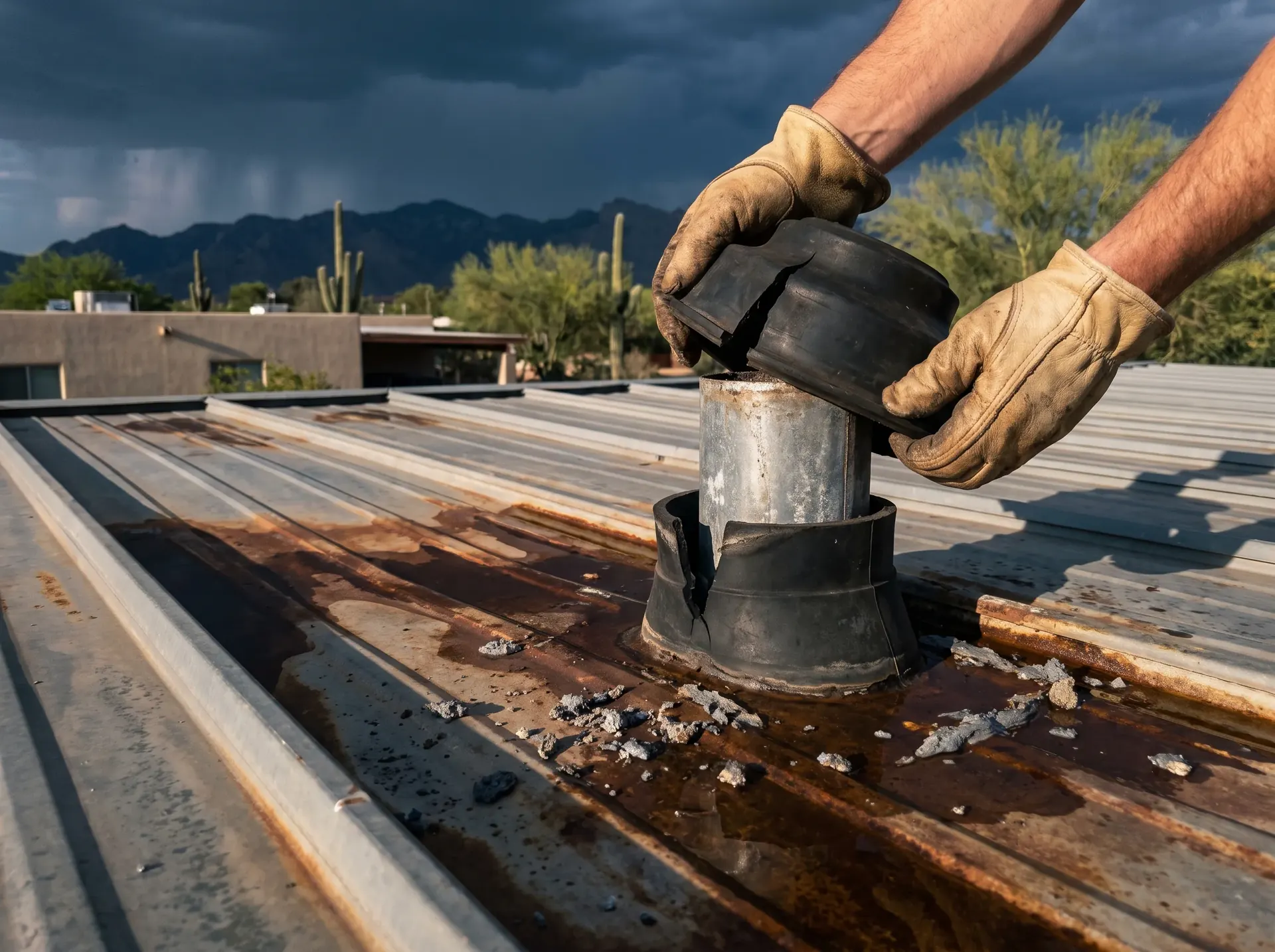
Every vent, pipe, cooler, curb, skylight, solar mount and abandoned opening, photographed. On an older Tucson roof this list is usually longer than expected.
Following the leak from underneath narrows it to a small area, and the penetration in that area is nearly always the answer.
Old sealant gets removed so the actual joint underneath can be seen. What looks like a small crack on top is regularly a detail that was never right.
Correct overlap, correct direction, water shed rather than dammed. Where counterflashing should be let into the wall, that is what happens.
They are the same age and they have had the same sun. Finding the next one now is worth considerably more than finding it in August.
Including the details that are still sound, so you know the roof was actually looked at rather than patched at one point.
Sealant protects a correctly made joint. It does not make one. A detail that only works because there is a bead of caulk on it is a detail that will leak again next monsoon, and covering it more thickly does not change that.
It is a specifically Tucson answer to a mystery leak and it gets missed constantly by anyone who does not work on these roofs regularly. Large perimeter, standing water, foot traffic, baked sealant.
You cannot assess a joint through three previous repairs, and new sealant will not bond to old failed sealant anyway. This is slower and it is the difference between a repair and a delay.
Capped vents, abandoned flues, old antenna mounts and solar standoffs from an array that was replaced. These are holes in your roof whether or not anything is using them.
Whatever the detail that failed, the two jobs below are where most of this work actually lands. If the description above did not quite match your roof, start with one of them.
Water shows up on a ceiling a long way from where it got in. We work backwards from the stain to the real entry point, repair that detail, and leave the twenty other places somebody would have sealed alone.
See how we fix it
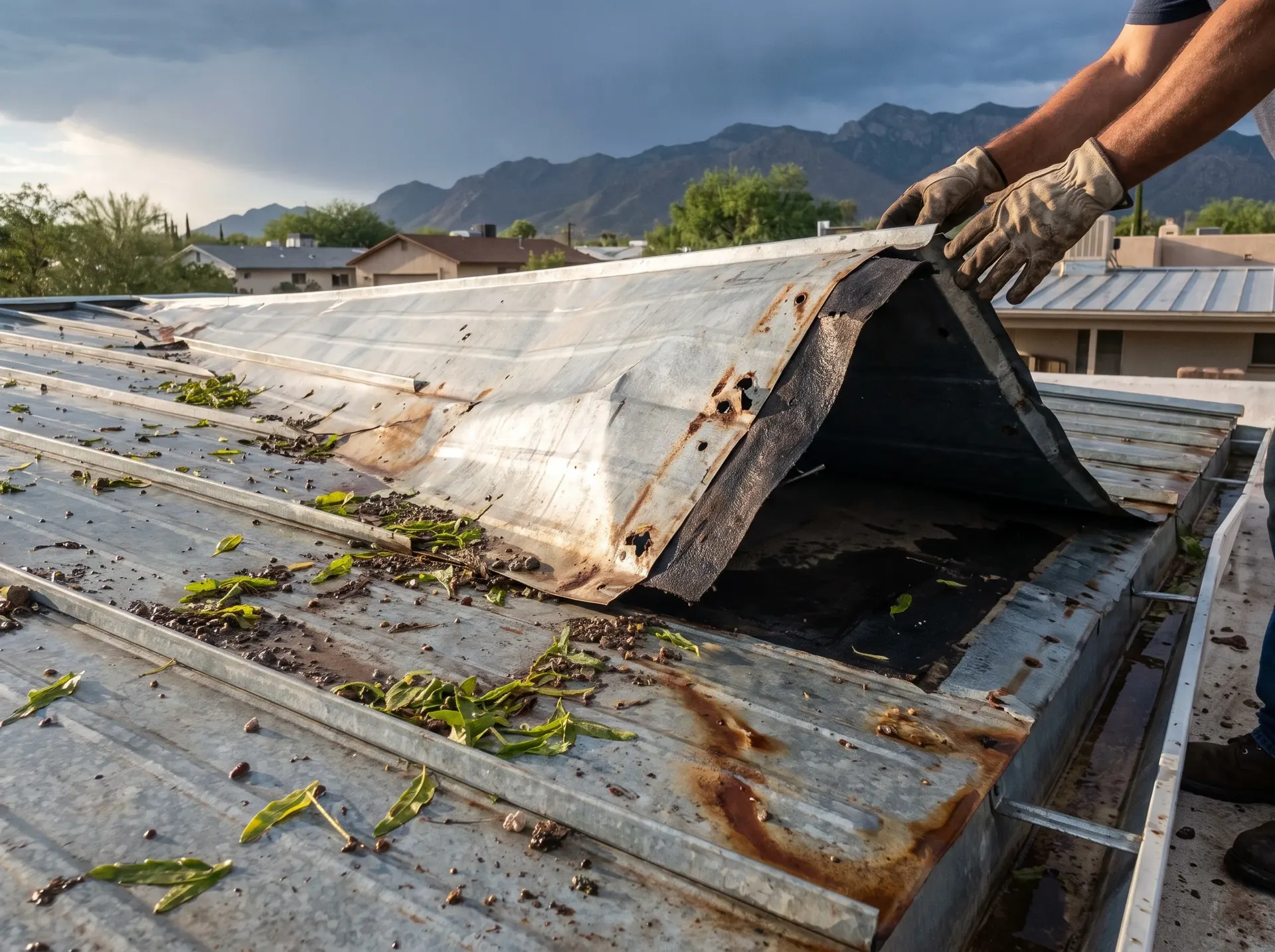
Lifted panel edges, fastener holes torn into slots by wind loading, driven rain forced under laps, and hail bruising out toward the Rincons. Storms break some things and simply expose others.
See how we fix it
Penetrations are the first thing worth ruling out, and a swamp cooler curb is the first of those in this city. Tell us what is on the roof and where the water shows up.
We have not collected any reviews yet. When we do they will appear here in full, in the customer's own words.
Penetrations and the flashing details around them. Pipe boots, cooler curbs, vents, skylights and wall transitions. The panel is a continuous piece of metal doing a simple job well. Every hole cut through it relies on a secondary detail made of shorter lived material, and those are what fail. Fasteners are the second cause, seams the third.
The right question is what joint it is going on, because no sealant fixes a bad detail. On metal the material has to stay flexible through very large daily movement and survive constant ultraviolet, which rules out most general purpose products. What matters more is preparation: a clean, dry, sound surface with the old failed material removed. Sealant applied over old sealant fails at the bond line no matter how good it is.
Not as a repair. Products like that can slow a leak down temporarily, and people reach for them mid storm, which is understandable. What they do afterwards is make the real diagnosis harder, because they hide the failed detail underneath a coating that has to be removed before anything proper can be done. If you have already used one, tell us. It changes how we approach the repair rather than stopping it.
At the curb and the flashing around it rather than through the glass or the dome. On a metal roof the specific weak point is the head, the uphill side, where water arrives and has to be diverted around the obstruction. If that detail was surface sealed instead of properly flashed, it will leak in driven rain long before it leaks in ordinary rain.
Usually not by sealing. A skylight leaking on a metal roof almost always means the curb flashing is wrong or has failed, and remaking that detail is the repair. Running sealant around the perimeter is the standard first attempt and it is why so many of them are on their third leak. If the flashing genuinely is sound and a joint has simply opened, then the joint gets cleaned back to bare material first.
The seals and gaskets on the unit have a service life and eventually need attention, yes. But when a skylight on a metal roof starts leaking, the flashing around it is a much more likely cause than the unit itself, and resealing the unit will not touch it. Establish which one you have before spending anything, because they are entirely different jobs.
Anywhere else in Pima County, call and ask.
Something went wrong sending that. Please call (520) 555-0132.
We have your details. If you said water is coming in right now, that goes ahead of scheduled work. Otherwise expect a call back during opening hours.