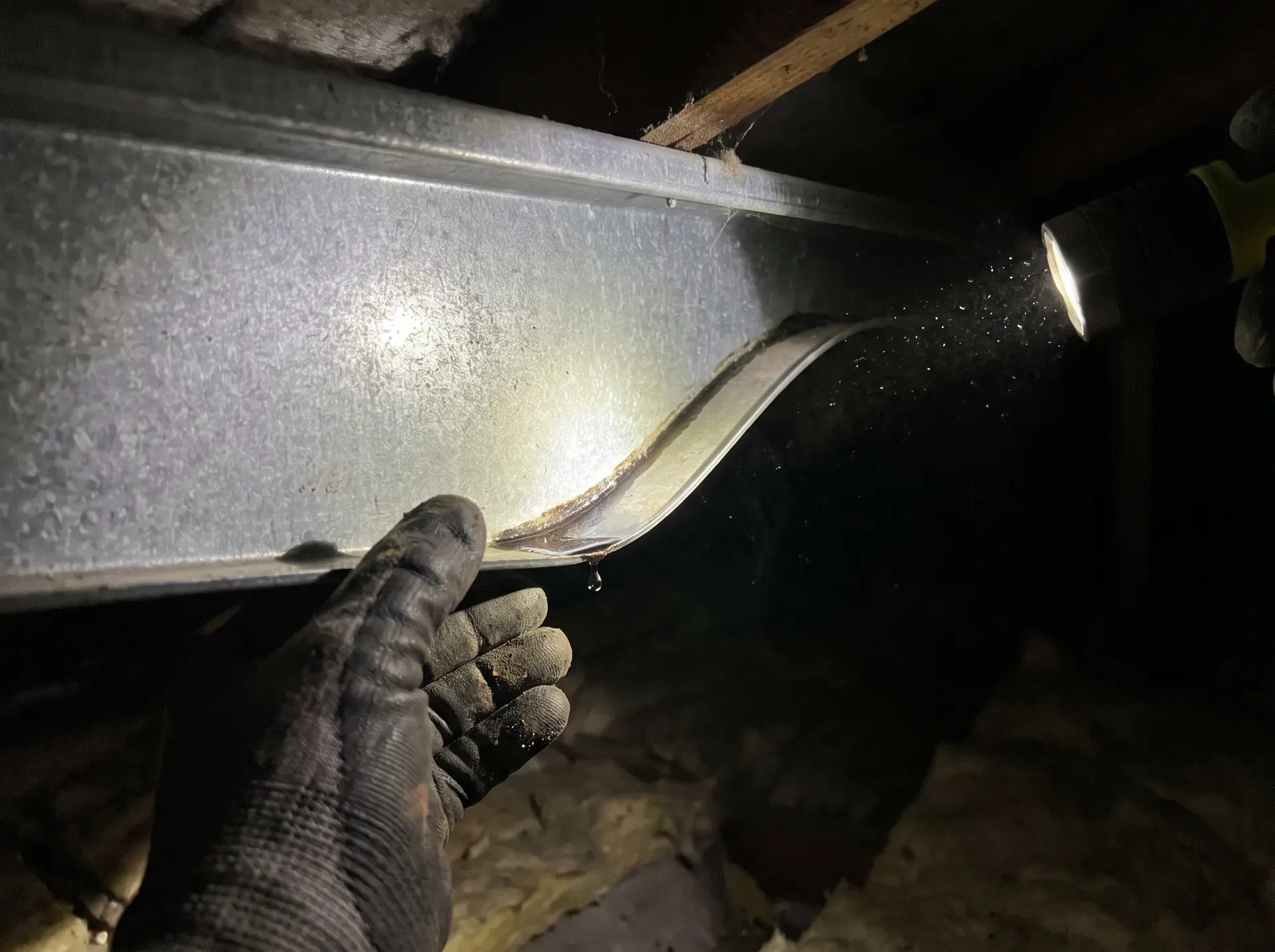
Metal Roof Leak Repair
Water shows up on a ceiling a long way from where it got in. We work backwards from the stain to the real entry point, repair that detail, and leave the twenty other places somebody would have sealed alone.
See how we fix it
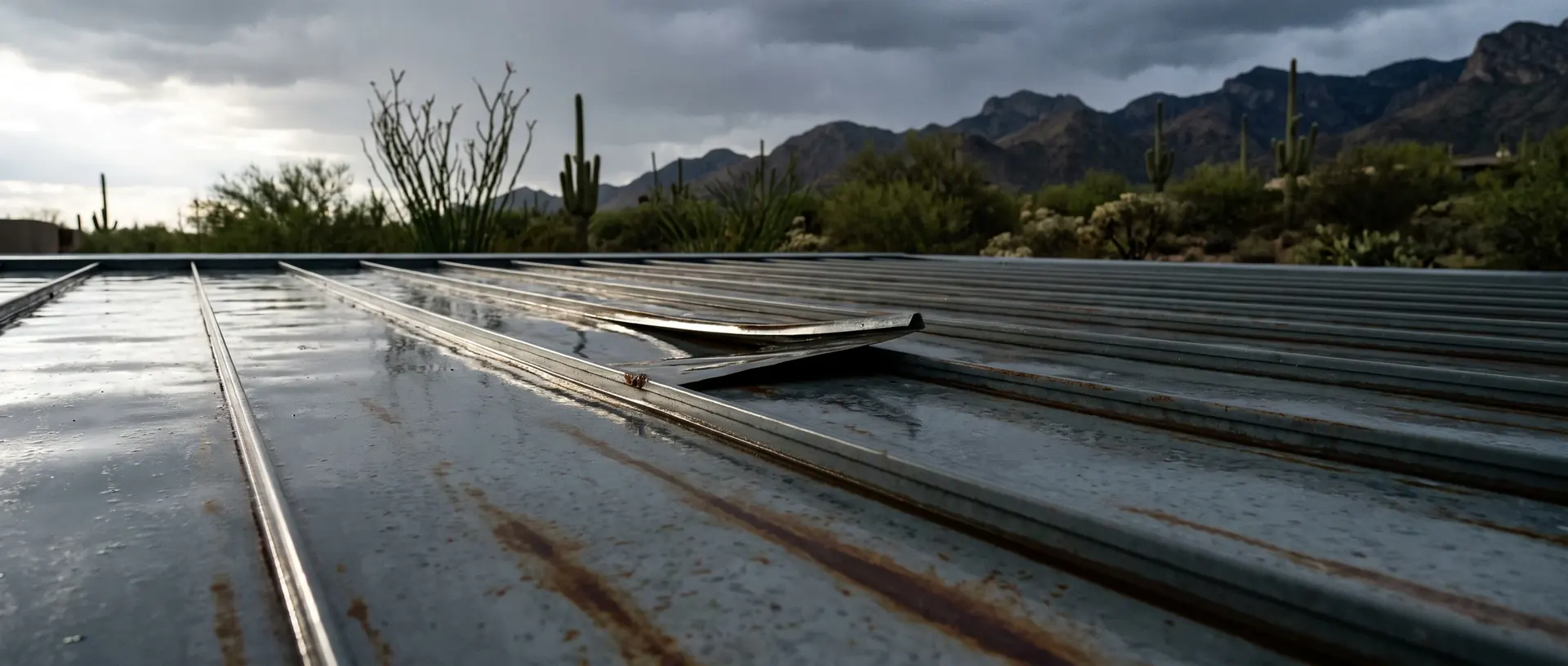
When the metal itself is the problem. Sprung seams, torn fastener holes, dented panels and end laps that have worked open after twenty summers of movement.
A long run of metal roofing is not a static object. It grows when it heats and shrinks when it cools, measurably, along its entire length, every single day. A well designed roof accounts for that. Standing seam systems use concealed clips that let the panel slide. Exposed fastener systems rely on the fasteners tolerating it. Either way, the movement never stops.
Over twenty years in this climate, that movement finds whatever was weakest. A standing seam that was not fully engaged when it went on gradually works its way open. An end lap that relied on sealant rather than geometry opens as the sealant hardens. Oil canning, the gentle waviness across a wide flat panel, concentrates stress at a fastener until the metal tears around it. And a panel that took a hail strike or a dropped tool has a bruise in the coating that becomes a corrosion site.
These are the failures where the metal itself is the problem rather than something attached to it. They are still repairs. What they need is somebody willing to work with the panel, reform it, re engage a seam, or cut in a section, rather than reaching for sealant because the alternative looks like hard work.
The fold that makes a standing seam watertight has come apart, or was never fully closed. It usually opens progressively along its length, and it leaks in driven rain long before it leaks in ordinary rain. Re seaming is the repair where the metal is still sound.
A screw that has worked an oval slot through the panel under thermal movement or wind loading. Once the hole has elongated it cannot be sealed and a bigger screw is often not enough on its own. The panel needs repairing at that point, not just refastening.
End laps that have opened as their sealant hardened, storm dented panels, and hail bruising where the coating has been driven into the metal and corrosion has started underneath. Southeast toward Vail and the Rincons this last one is a genuine category rather than a rarity.
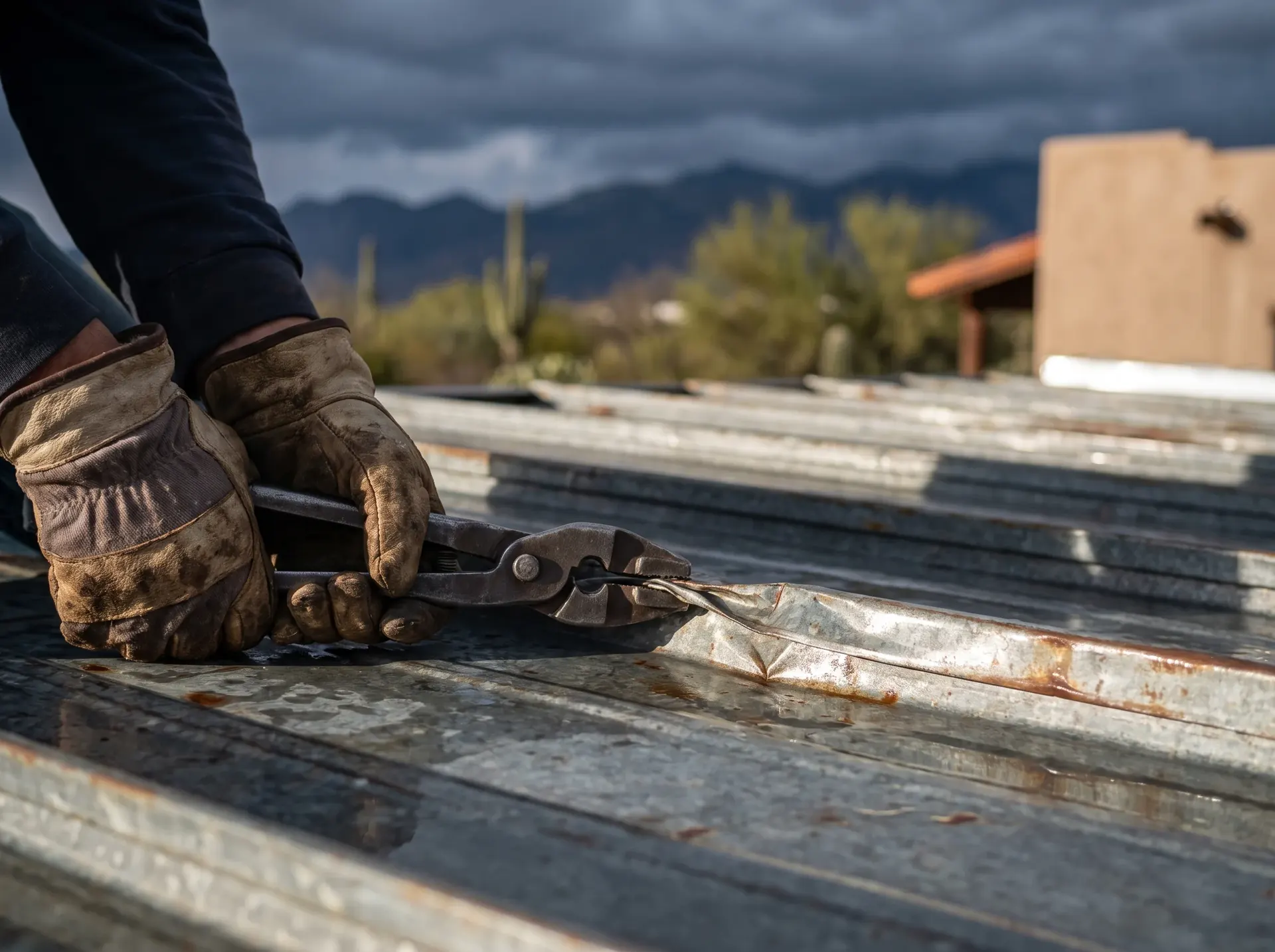
Getting the profile and the seam type wrong at this stage means every decision after it is wrong too.
A seam that opened because the panel is restrained somewhere will open again after any repair. The cause is more useful than the symptom.
Honestly, and with the reasoning explained. Sound metal gets reworked. Torn or thinned metal gets a section, because a patch over damaged steel is a temporary measure dressed up as a repair.
Clips that still slide, laps that still work as laps, fasteners that still have their tolerance. The roof has to keep moving after we leave.
Every new cut edge is a fresh corrosion site if it is left bare, and in this climate it will not stay bare looking for long.
A new section on a twenty year old faded roof does not match, and you should hear that from us before the work rather than after it.
A torn fastener hole covered in sealant is the standard cheap answer and it lasts about one monsoon. Working the metal is harder, and it is the difference between a repair and a delay.
The commonest way a well intentioned panel repair fails is by fixing the panel too rigidly. The movement does not stop, so the failure simply relocates. Designing for that is most of the skill in this particular job.
A replacement section on a sun faded roof will be visible. Anyone promising an invisible repair on twenty year old metal has not looked at how far your finish has moved. We would rather you know in advance and decide.
A localised failure on an otherwise sound roof is a localised repair. It gets quoted as a replacement remarkably often, and we do not do replacements.
Whatever the detail that failed, the two jobs below are where most of this work actually lands. If the description above did not quite match your roof, start with one of them.
Water shows up on a ceiling a long way from where it got in. We work backwards from the stain to the real entry point, repair that detail, and leave the twenty other places somebody would have sealed alone.
See how we fix it
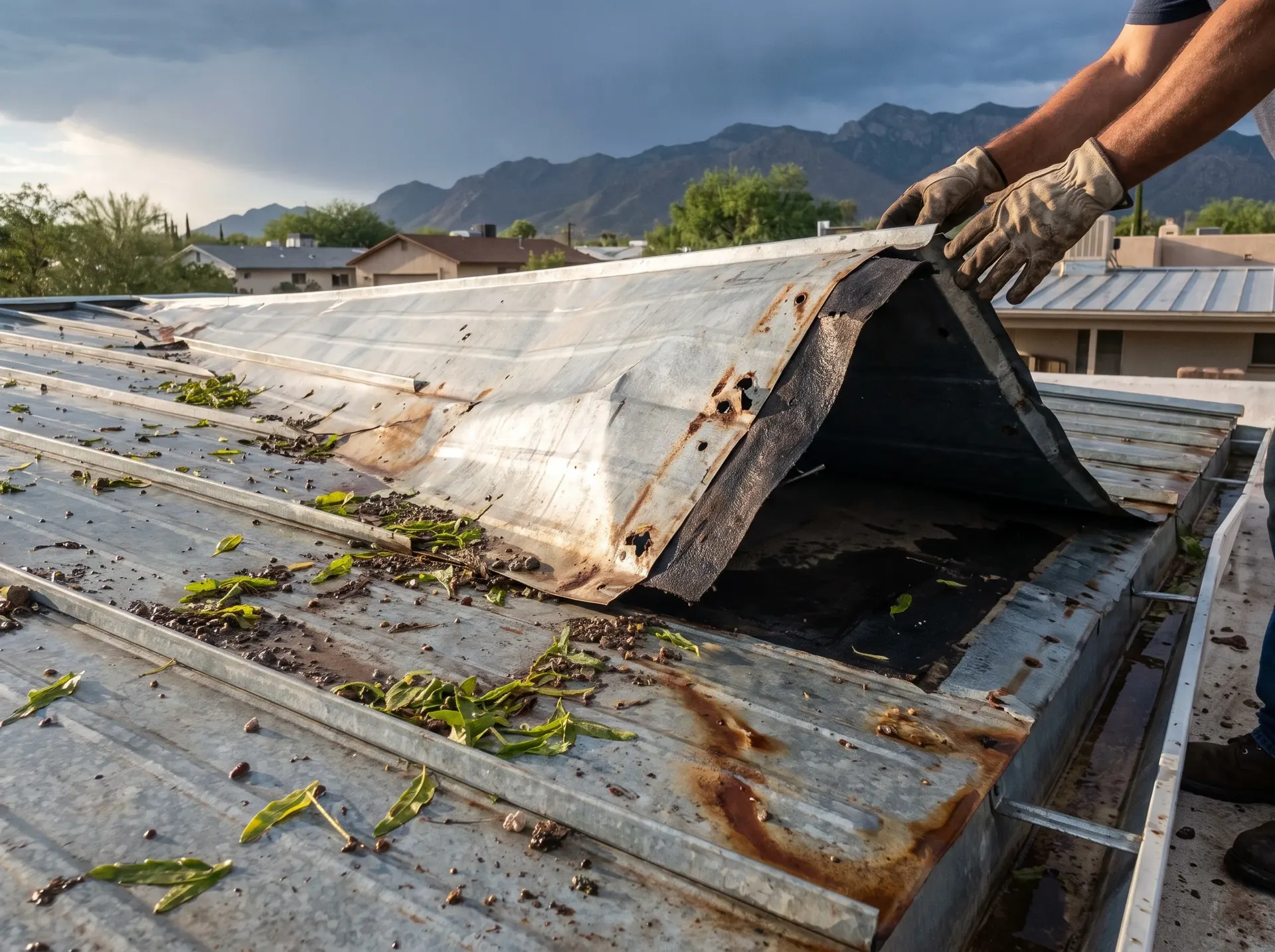
Lifted panel edges, fastener holes torn into slots by wind loading, driven rain forced under laps, and hail bruising out toward the Rincons. Storms break some things and simply expose others.
See how we fix it
Tell us what kind of roof it is if you know, and roughly where the damage is. Photographs help a great deal with this one.
We have not collected any reviews yet. When we do they will appear here in full, in the customer's own words.
It depends on what has failed, how big the area is and how hard the roof is to get onto. A perished pipe boot and a torn panel section are both metal roof repairs and they are not remotely the same job. What is consistent is that a localised panel or seam repair sits a very long way below a replacement, which is why it is worth establishing which one you actually need before accepting a quote for the larger.
In this climate, in order: fastener washers perishing and screws backing out, penetration details failing, sealant at laps and seams hardening and shrinking, coating chalking away and letting corrosion start at cut edges, and storm damage lifting edges or tearing fastener holes. Panels themselves failing structurally is well down the list, which is why so many roofs get replaced with perfectly good metal on them.
Much less likely than the alternatives while the details are maintained, and reliably once they are not. The panel is a continuous water shedding surface and it does that job well for decades. Everything with a shorter life is attached to it. A metal roof that leaks is nearly always telling you about a washer, a boot, a lap or a seam rather than about the metal.
Long, and largely determined by maintenance rather than by the material. Panels routinely outlast the fasteners, sealant and coatings around them by a wide margin. The practical lifespan of any given roof is set by whether those shorter lived components get renewed, which is why two identical roofs of the same age can be in completely different condition.
Yes, including the panels themselves. Seams can be re seamed, torn areas can be repaired, and individual sections can be cut in and replaced without touching the rest of the roof. Localised damage on a metal roof is one of the more repairable situations in the whole trade, which sits oddly with how often it gets used as a reason to replace the lot.
Repair, if the panels still have their thickness and the structure underneath is dry. Replace, if corrosion has perforated widely, or if water has been getting in long enough that the decking and framing are compromised. The decision is about the condition of the metal and what is under it, not about the roof's age or how bad it looks from the driveway.
Anywhere else in Pima County, call and ask.
Something went wrong sending that. Please call (520) 555-0132.
We have your details. If you said water is coming in right now, that goes ahead of scheduled work. Otherwise expect a call back during opening hours.