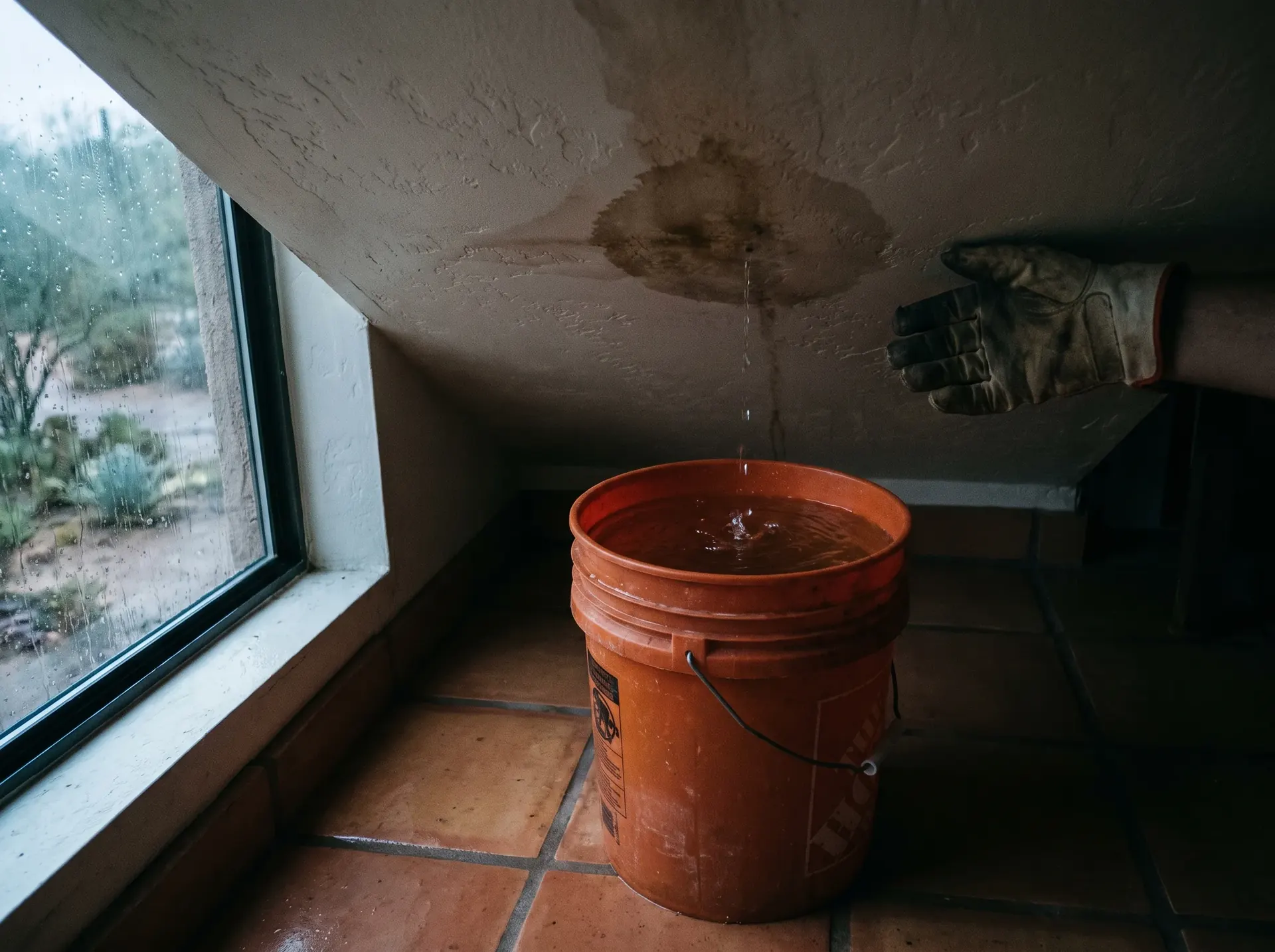
Emergency Roof Leak Repair
Water coming into the house while the storm is still going. We stabilise the intrusion, then come back and do the repair properly once the roof is dry enough to stand on safely.
See how we fix it
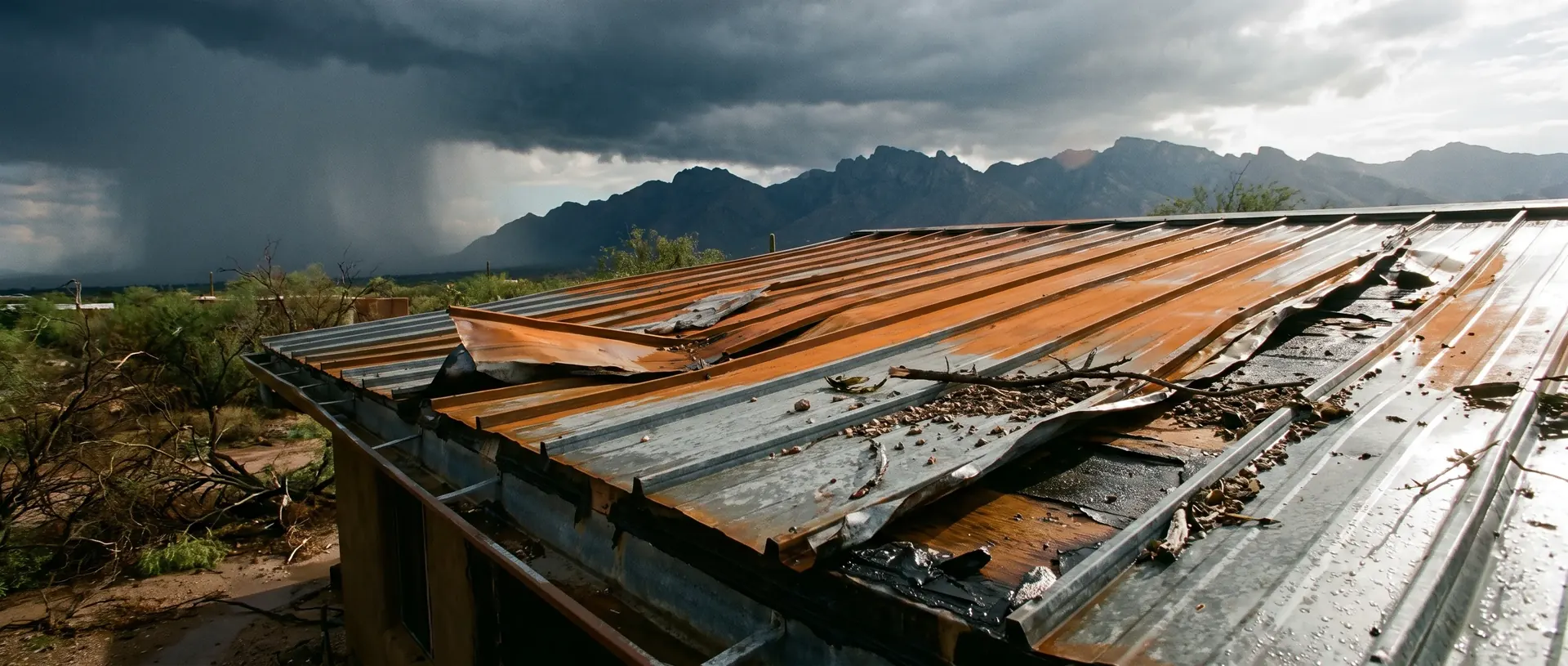
A microburst does not damage a good roof at random. It finds everything that was already marginal and finishes it, all in about eleven minutes.
Monsoon season here runs from early July into September, and the damage it does to metal roofs is not the damage a general storm does elsewhere. There is no snow load, no ice, no hurricane duration. What there is instead is a microburst: a column of air dropping out of a collapsing thunderstorm cell, hitting the ground and spreading outward in every direction at once.
That produces two things a roof hates. Sudden uplift on any edge that is not held down properly, and rain moving horizontally rather than falling. Horizontal rain does not care about slope. It goes under laps, into the open side of a curb, behind counterflashing and up the underside of a drip edge.
So after a bad cell you get two categories of problem, and it matters which is which. There is genuine damage, where wind physically deformed or lifted metal that was sound the day before. And there is exposure, where a detail that had been quietly failing for five years finally met a storm that could exploit it. The first is a storm event. The second is a maintenance backlog that a storm just billed you for.
We tell you which one you have, honestly, because the answer changes what you do about it and it changes what an insurer is likely to say.
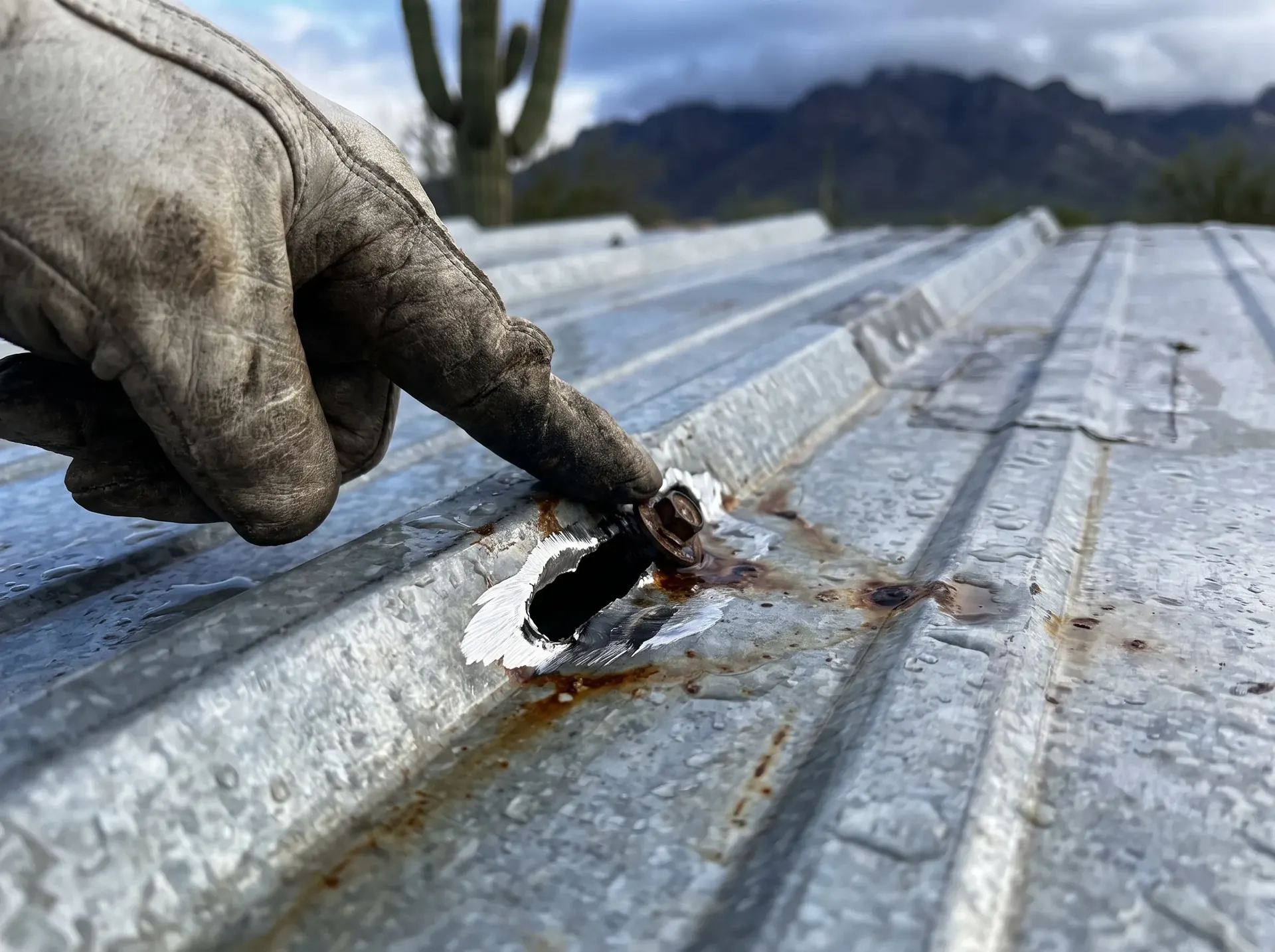
Eaves, rakes, ridge caps and any panel edge that was already loose. Wind gets under it, lifts it, and works it up and down until the fastener tears an oval slot through the metal. Once a screw is moving in a slot rather than sitting in a hole, it is no longer holding anything down or sealing anything.
The most common storm call, and the most misunderstood. Nothing looks broken. Water was simply pushed sideways into a lap, a curb or a wall flashing that sheds ordinary rain perfectly well. The roof photographs as undamaged and the ceiling says otherwise.
Hail, which is a real category southeast toward Vail and the Rincons rather than a theoretical one, and anything the wind carried. Dented panels, bruised coating where the finish has been driven into the metal, and palo verde and mesquite debris packed into valleys and behind curbs where it holds water for weeks afterwards.
Which night, what you heard, and what you have seen since. If water came in during the cell and stopped when it stopped, that is a very different problem from a slow drip that started afterwards.
If water is still getting in, stabilising that comes before diagnosis. Nothing is gained by a perfect assessment of a roof that is still letting water into the house.
Not only where you saw water. Uplift at a rake edge two rooms away is extremely common and extremely easy to miss.
Torn fastener slots, deformed metal and impact bruising are storm events. A perished boot and chalked coating are not, and we will say so rather than let you find out from an adjuster.
Edges refastened and reformed, torn holes dealt with properly rather than filled, flashing remade, debris cleared out of the places it will do damage sitting there.
Whatever is currently marginal is what breaks in August. You get that list.
After a bad cell there is a great deal of money in saying otherwise, and a lot of it gets said. We do not replace roofs, so we have no reason to inflate what the wind did.
The hardest storm call is the one where nothing is damaged and water still came in. It gets missed constantly because the roof passes a visual inspection. It is usually a lap or a curb detail, and knowing to look there saves a great deal of time.
A screw that has worked an oval slot cannot be re driven into the same hole and cannot be sealed. It needs an oversize fastener or a proper repair to the panel. Simply putting the screw back is one of the most common bad storm repairs there is.
July to September is when this trade earns its living here. We are not fitting storm calls around a replacement schedule, because there is no replacement schedule.
Finding the failure is one job. Putting it right is usually one of these, and which one depends on what the roof turned out to be doing.
Water coming into the house while the storm is still going. We stabilise the intrusion, then come back and do the repair properly once the roof is dry enough to stand on safely.
See how we fix it
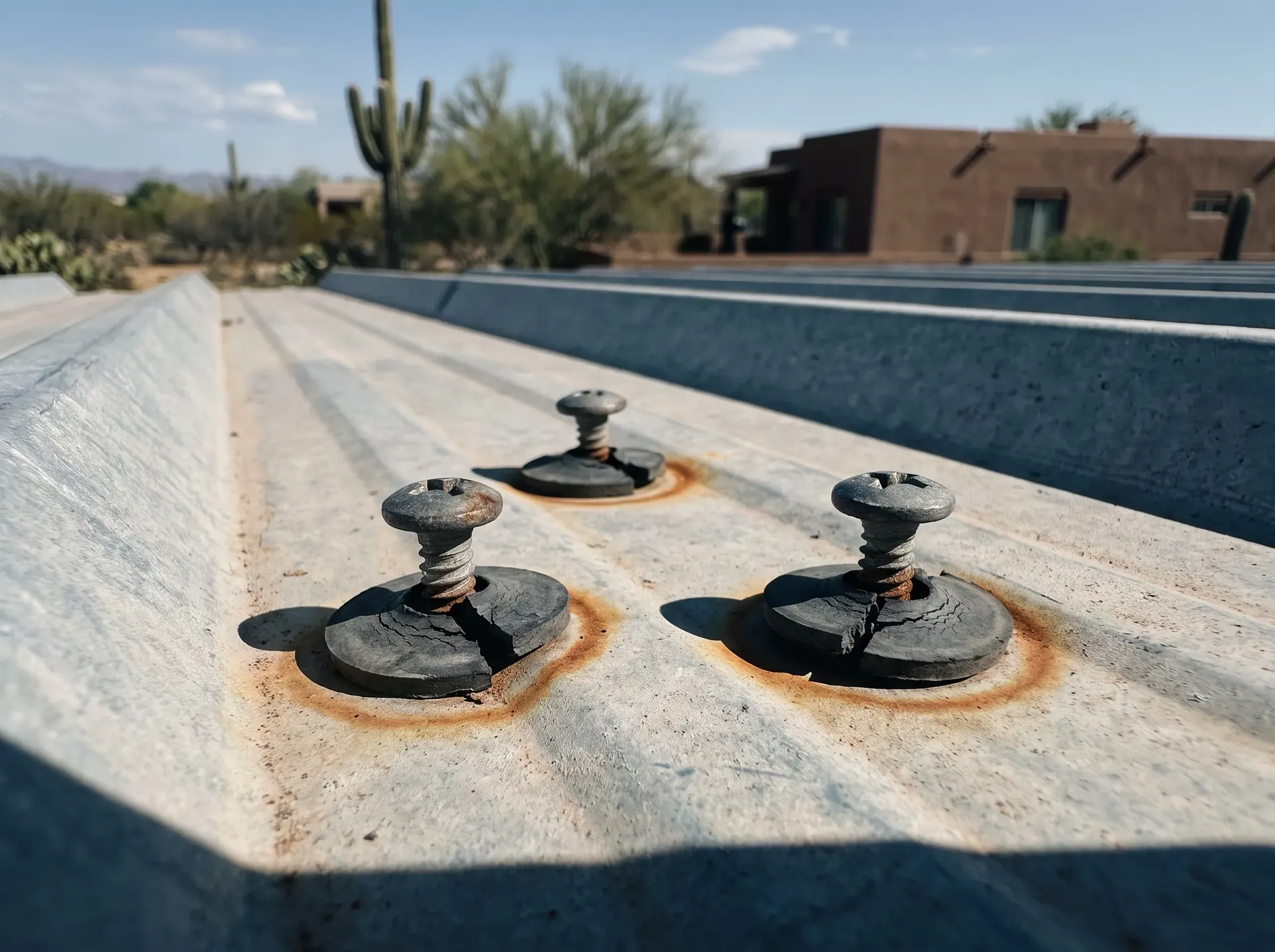
An exposed fastener roof holds itself down with hundreds of screws and seals itself with hundreds of rubber washers. Both have a service life in this climate, and it is shorter than the roof's.
See how we fix it
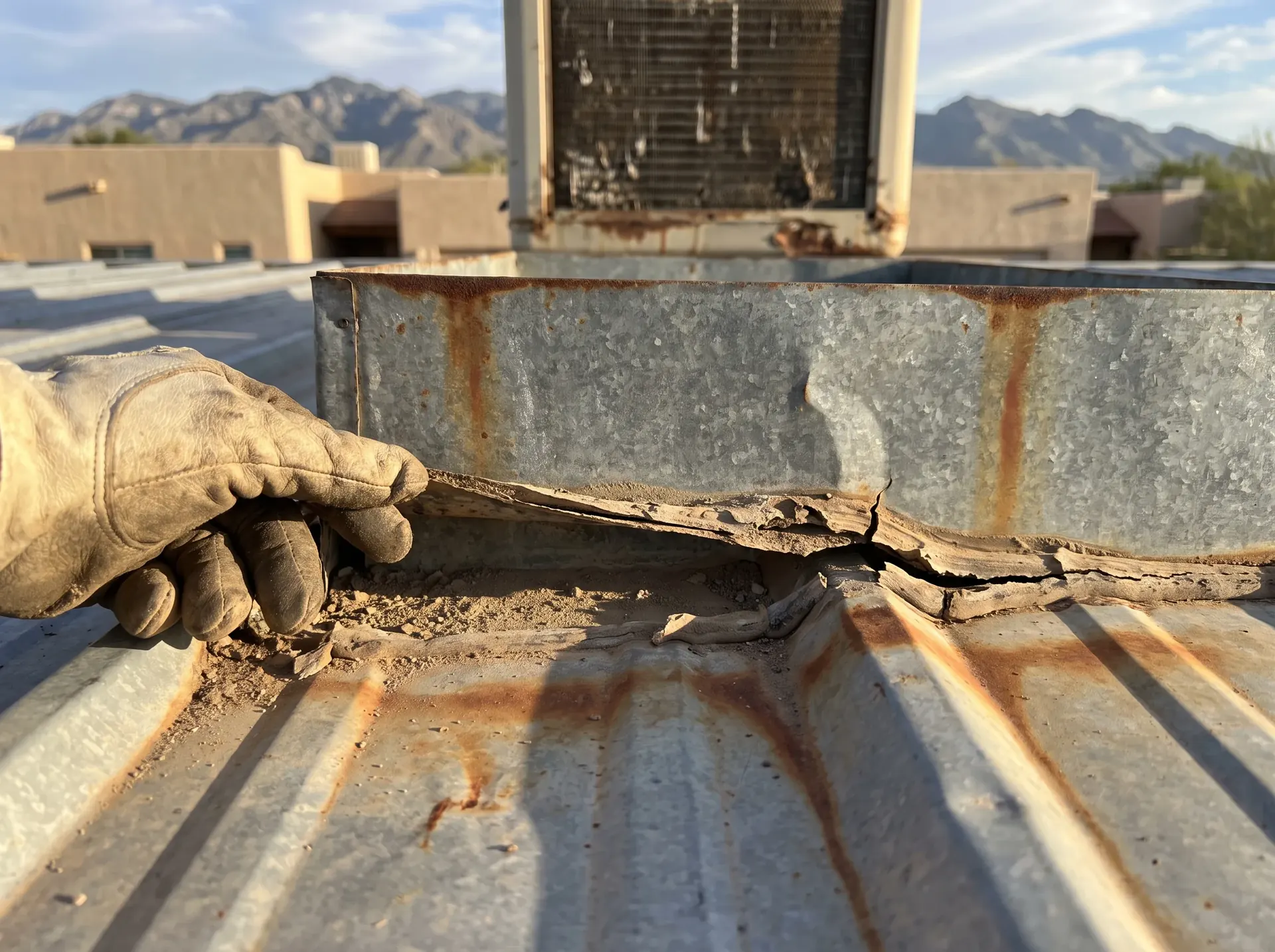
Pipe boots, swamp cooler curbs, vents, valleys, headwall and sidewall flashing. More metal roofs leak here than anywhere else, and almost none of them leak through the middle of a panel.
See how we fix it
Tell us which night and what you have seen since. If water is still coming in, say so first and we will treat it that way.
We have not collected any reviews yet. When we do they will appear here in full, in the customer's own words.
Protect what is underneath first. Move things out of the way, get a container under the drip, and put a small hole in the centre of any ceiling bulge so the water drains in one place instead of bringing the whole sheet down. Photograph everything while it is happening. Then call. Nobody should be climbing onto a wet metal roof during a monsoon cell, including us.
Generally when sudden accidental damage caused it, and generally not when gradual deterioration did. That is exactly why separating storm damage from an existing backlog matters so much, and why a dated, photographed condition report is worth having. We can tell you honestly which category we think each item is in. What an individual policy actually covers is between you and your insurer.
It depends entirely on why the rain got in. Wind that lifted a panel and let water underneath is usually treated very differently from a pipe boot that perished over eight years and finally gave up. Both feel identical from inside the house. The distinction is made on the roof, which is why the assessment is worth doing properly before a claim rather than after one.
It is if water is actively coming into the house, if it is anywhere near electrical fittings, or if a ceiling is holding water and sagging. It is not an emergency if a stain appeared after a storm and is now dry, although it is still a diagnosis that should not wait until next season. Say which of those you have when you call and it will be treated accordingly.
Not much safely, during the rain itself. Afterwards, the useful things are keeping valleys and behind curbs clear of debris so water can actually leave the roof, and having fasteners and penetration details looked at before monsoon season rather than during it. Most storm leaks are a detail that was already open, and June is a much better month to find those than August.
The metal is rarely what suffers. Insulation stops working as soon as it is wet and does not recover, decking and framing deteriorate once they stay damp, and drywall stains permanently. In a climate this dry it is easy to assume everything dried out, but material sealed under insulation or above a ceiling does not get the chance.
Anywhere else in Pima County, call and ask.
Something went wrong sending that. Please call (520) 555-0132.
We have your details. If you said water is coming in right now, that goes ahead of scheduled work. Otherwise expect a call back during opening hours.