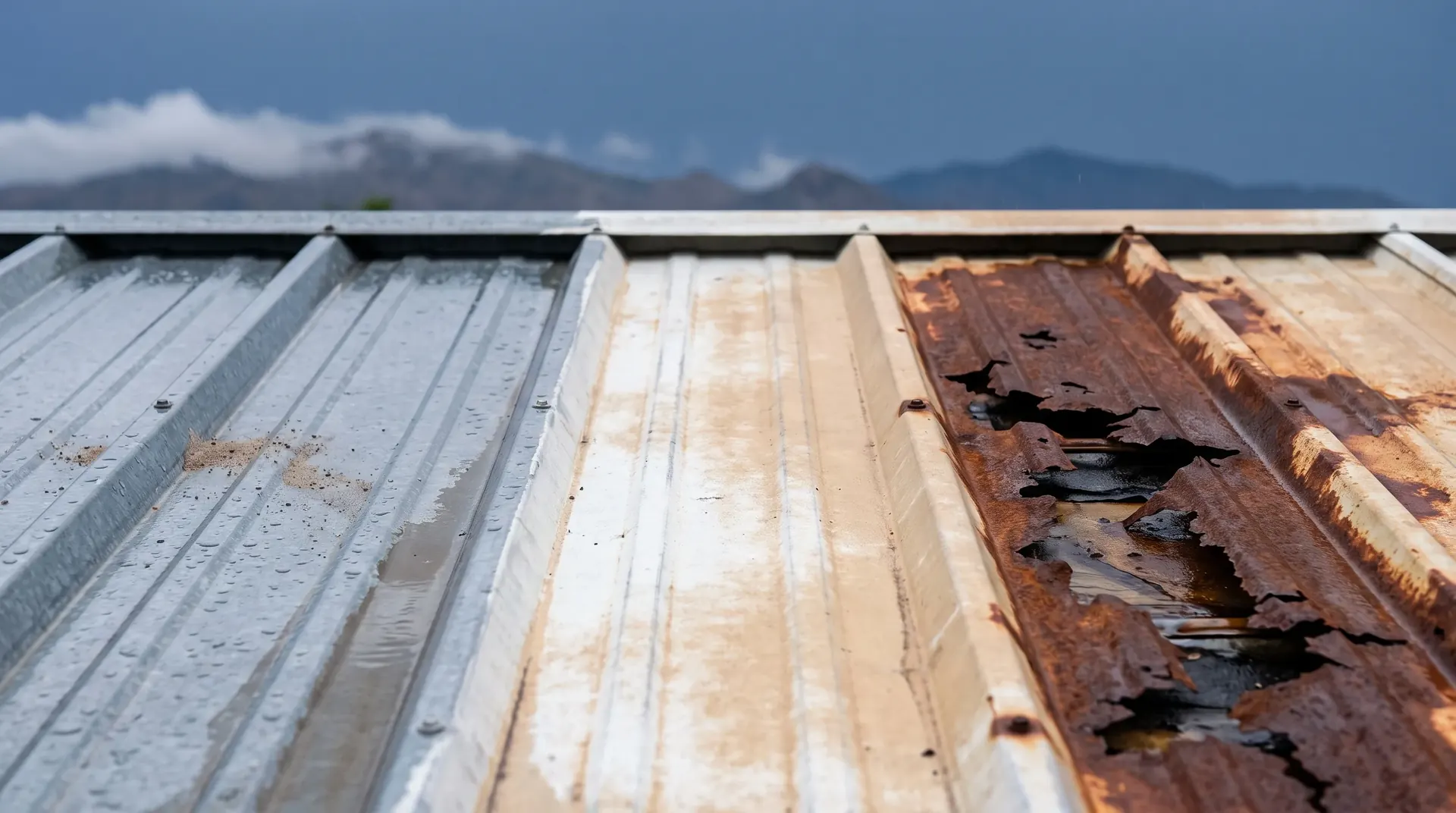
There are three honest answers to a tired metal roof, and they cost wildly different amounts. Most roofs get sorted into the most expensive one, and a large proportion of those did not need to be.
The test is not the age of the roof and it is not how bad it looks from the driveway. It is a single question with three possible answers: does the steel still have its thickness, and is what is underneath it dry?
Work through that honestly and the decision makes itself.
Repair, when the failures are specific
This is the right answer when you can point at what is wrong. A cracked pipe boot. Sixty backed out screws. A sprung seam along one run. A wall flashing that was surface sealed instead of properly formed. Rust at the cut edges of the eave.
The defining characteristic is that the rest of the roof is fine. The panels have their full thickness, the structure underneath is dry, and there are a countable number of failed details.
Most leaking metal roofs in Tucson are in this category, and it includes plenty that have been quoted for replacement. A roof can look genuinely alarming, chalked to grey, orange along every cut edge, screws visibly proud, and still be structurally sound metal with a list of repairs attached to it.
Recoat, when everything is tired at once
This is for the roof where nothing in particular has failed but everything is at the end of its middle age. The coating has chalked away, the sealant at every lap has gone hard, the fastener washers are all the same age, the surface runs hot enough to keep driving the movement that is ageing it.
Repairing that one detail at a time is possible and it is not sensible, because there are hundreds of details all at the same point. A restoration coating puts a continuous membrane over the whole surface in one operation, bridging every lap and fastener head, and a reflective one brings the surface temperature down, which reduces the daily movement working against every fastener.
The conditions are that the panels must still be sound, and whatever is underneath must be dry. Coating over perforated metal or wet insulation seals a problem in and it keeps growing where you cannot see it.
Repairs happen first, then the coating goes over a roof that is already watertight. A coating is not a repair and treating it as one is the most common way these jobs fail.
Replace, when the metal or the structure has gone
Some roofs genuinely are finished, and pretending otherwise serves nobody.
The clear signals are widespread perforation, where corrosion has gone through the panel in multiple places rather than at one edge, and panels that have thinned enough that there is not enough steel left to repair to. Extensive structural damage to the decking or framing from water that has been getting in for years is the other one, and it is the more serious of the two, because at that point the roof covering is not the problem.
If you are in that position, you need a replacement contractor. We do not do that work and we will tell you plainly when you have reached it rather than selling you a coating that postpones the conversation by a season.
How to tell which one you are in
You cannot do this from the ground and you should not try to do it from the roof yourself. But you can understand what somebody ought to be checking.
Whether the steel is sound is established by probing and sounding it, not by looking at the colour. Rust that stains is different from rust that has eaten thickness, and only one of those matters. Where the rust is tells you a great deal too: corrosion along every cut edge and around fastener holes is normal ageing, because the protective coating stops at a cut. Corrosion blooming in the middle of panels is more serious, because something has failed where there was no reason for it to start.
What is underneath has to be checked as well. Wet or compressed insulation, damp decking, or staining on framing all change the answer, and none of it is visible from above.
The last thing worth knowing is who is telling you. A contractor whose only product is a replacement has one answer available to them. That does not make them dishonest, but it does mean a second opinion from somebody without that incentive is worth getting before you commit to the most expensive of the three options.