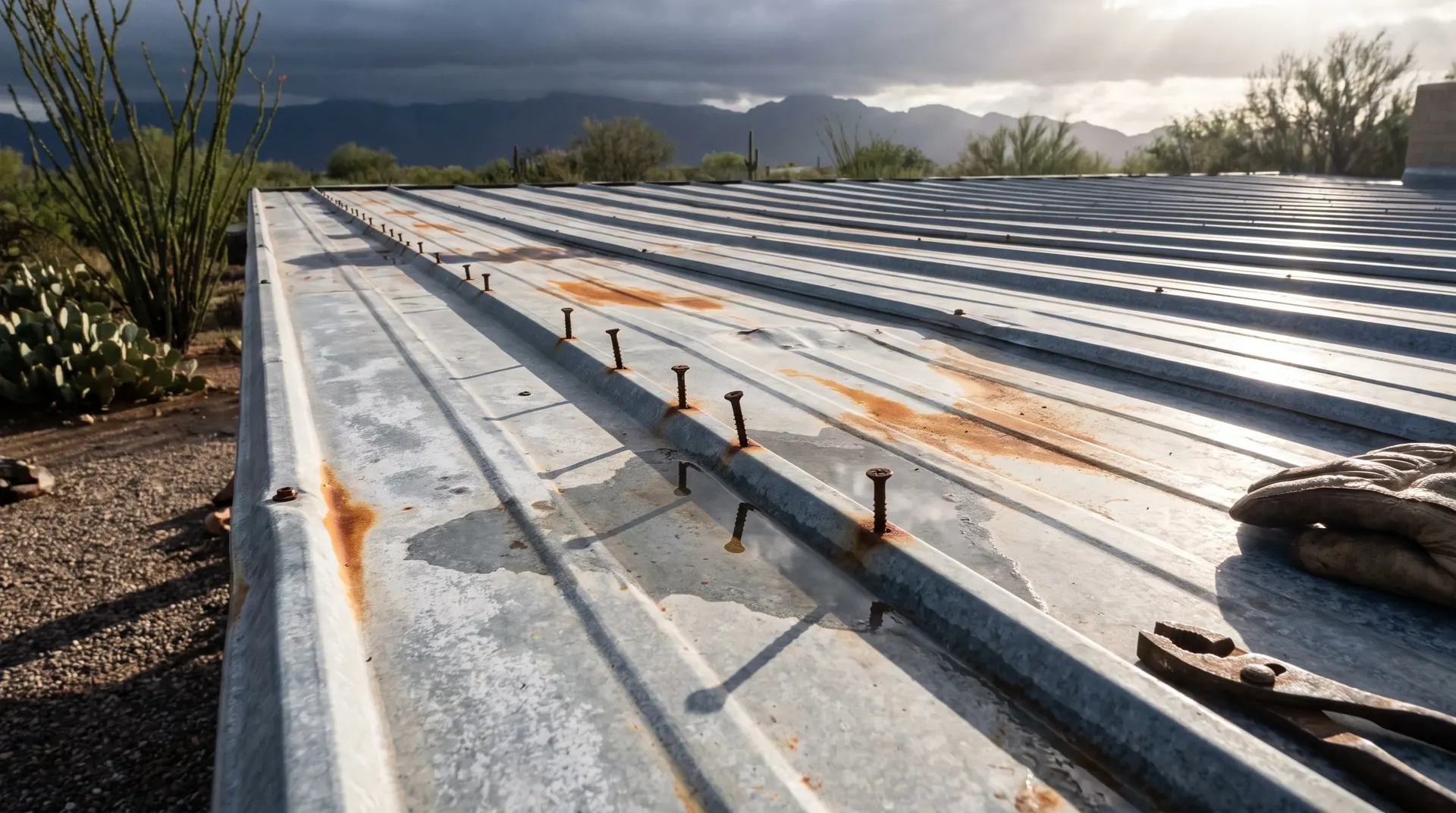
If you can stand in your driveway and see a line of screw heads sitting proud of the panels on your roof, nothing has gone wrong with your roof. What you are looking at is the most predictable thing that happens to an exposed fastener metal roof in this climate, and it happens to all of them eventually.
The short version: your roof gets very hot during the day and cools right down at night, the panel grows and shrinks along its whole length every time it does that, and the fasteners are what that movement works against. Do it a few thousand times and the screws start to walk.
It is not a defect and it is not bad installation. It is the roof reaching the point where it needs the maintenance nobody told you it would need.
Thermal movement is a bigger force than it sounds
Metal expands when it heats. Everyone knows that, and it sounds like a technicality until you look at what it means on a roof.
A Tucson metal roof in July goes from a cool night to a surface temperature that is far above air temperature by mid afternoon, because it is a dark or faded metal surface in the strongest sun in the country with nothing shading it. It does that every single day. The panel gets measurably longer through the afternoon and shorter overnight, along its entire run.
Something has to absorb that. On a standing seam roof, concealed clips let the panel slide, which is precisely why those roofs do not have this problem. On an exposed fastener roof, the screws are driven through the face of the panel into the purlin, so the panel cannot slide. The movement instead applies force to every fastener, thousands of times a year, in alternating directions.
Given long enough, that force does exactly what repeated alternating force always does to a threaded fastener. It works it loose.
The washer fails before the screw does
Here is the part that matters more, and the part people miss because it is invisible from the ground.
The screw is not what makes your roof watertight. The rubber washer bonded under its head is. It compresses when the screw is driven and seals the hole. That washer is an organic material sitting exposed to direct ultraviolet, at high temperature, being flexed by the same daily movement, for years.
It hardens. Then it cracks. Then it squeezes out sideways from under the head into a flat splayed ring that seals nothing.
At that point the screw can still be perfectly tight and your roof still has an open hole in it, with water running straight down the shank. This is why “the screws look fine” is not a useful assessment from the driveway, and why roofs that have never had a visible loose screw still leak at their fasteners.
What makes it happen faster
Not every roof gets there at the same rate. The things that accelerate it are all present in Tucson and some are worse on particular houses.
Long panel runs move more in absolute terms than short ones, because the expansion is proportional to length. Dark colours run hotter than light ones and swing through a wider range. West and south facing slopes take more load than north facing ones. And screws that were originally overdriven, crushing the washer at installation, never had a full service life to begin with. Underdriven ones never sealed properly at all.
The one that catches people out is uniformity. Every screw on your roof went in on the same day, into the same conditions, with washers from the same batch. They do not fail one at a time over twenty years. They reach the end together.
What the repair actually is
Replacing a backed out screw with the same screw in the same hole does not work, and it is the most common bad repair in this trade. The hole has usually widened, the threads in the purlin may be compromised, and a fastener that walked out once will do it again.
A proper job uses an oversize replacement screw, longer and larger in diameter, so it bites into sound material rather than the worn hole. It gets a new bonded washer. And it is driven to the correct depth, which means the washer compresses and no further. Driving to feel, or driving everything as tight as the gun will go, crushes the washers and puts you back where you started within a season.
Where a hole has worked into an oval slot, usually from wind loading rather than heat, a bigger screw alone is not enough. The panel itself needs repairing at that point.
The other real decision is scope. If a meaningful proportion of a roof’s fasteners have gone and they are all the same age, replacing only the failed ones means an annual return visit. Doing the whole field once is generally cheaper across a few years, and it is a conversation you should be offered rather than one you have to raise.