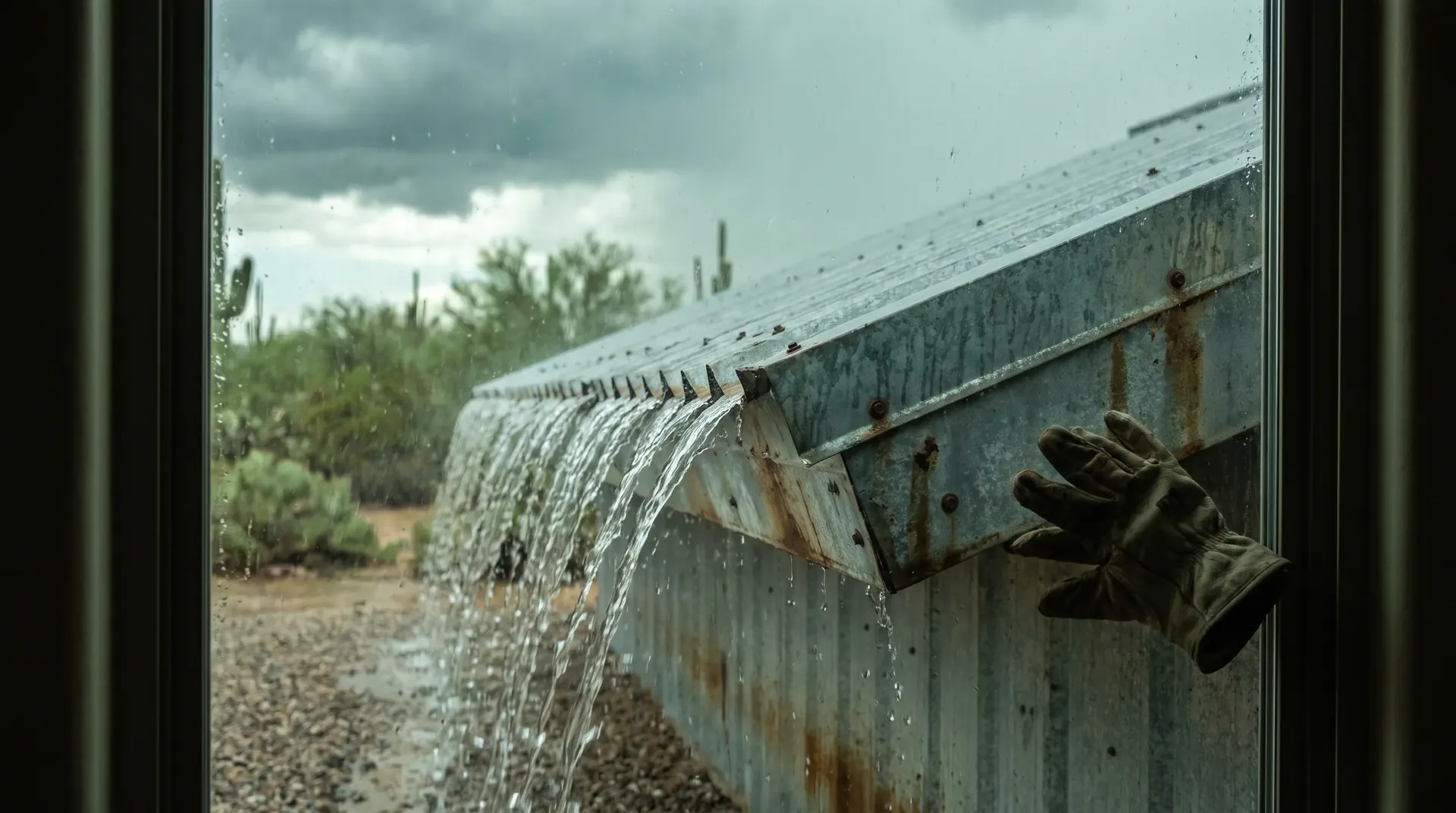
Almost everything expensive about a roof leak happens in the first hour, and almost all of it is preventable from inside the house. Nothing useful happens on the roof tonight.
Work down the list below in order.
Contain the water and protect what is underneath
Get a container under the drip. If it is landing on carpet, put something waterproof down first, because a bucket catches the drip and not the splash.
Move furniture, electronics and anything with sentimental value out of the area entirely rather than covering it in place. Water finds its way under a sheet.
If the drip is fast, swap containers before they overflow rather than after. Most of the flooring damage in these situations comes from a bucket nobody emptied.
Release a bulging ceiling deliberately
This feels wrong and it is the right thing to do.
If a section of ceiling is holding water and sagging, put a small hole in the lowest point of the bulge with a screwdriver, with a container underneath. The water drains in one controlled place.
Left alone, that pocket keeps filling until the drywall lets go, and then you lose the whole sheet, everything under it gets soaked at once, and the repair is far larger. One small hole is a patch. A collapsed ceiling is a room.
Photograph everything while it is happening
This is the step people skip and regret, because once it stops raining the evidence starts disappearing.
Photograph the water actively coming in, the stain at its worst, the bulge before you drain it, anything damaged, and the containers in position. Get a shot wide enough to show which room and which part of the ceiling.
Note the date and time, and note what the weather was doing: whether it was a full cell with wind driving the rain sideways, or steady rain. That single detail narrows the diagnosis enormously later.
Once the storm has passed, look in the roof space
If you have roof space access and you can reach it comfortably, take a torch and look at the purlins and decking above the stain for a damp line, a rust trail or a track where the dust has been washed away. Follow it uphill. Its highest point is under where the water entered.
Do not do this while the storm is still going, and do not do it if the access is awkward. It will keep until morning.
What not to do
Do not go on the roof. It is worth saying a third time because people do it anyway.
Do not spray a sealer product at the ceiling or into the roof space. It does not stop the leak and it makes the real diagnosis harder.
Do not assume it has stopped because the drip stopped. The rain stopped. Water that got into insulation is still there and will be there in a week.
Do not paint over the stain until the leak is fixed and the material behind it is dry. It hides the only visible record you have of whether it is still happening.