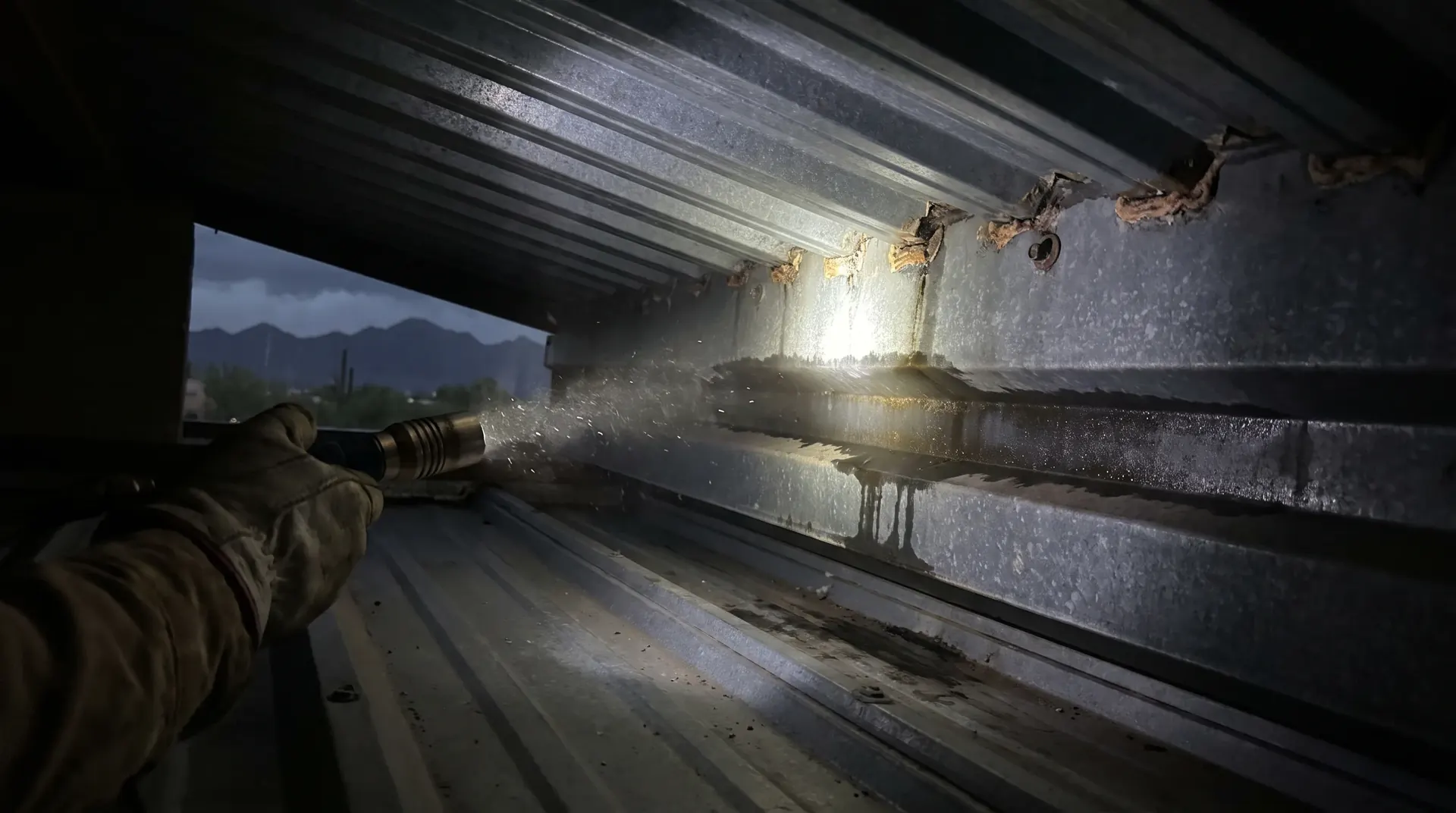
The single most useful thing to understand about a metal roof leak is that the wet patch on your ceiling is almost never underneath the hole. Water enters somewhere up on the roof, lands on the top of a purlin or a batten, and then travels sideways along that steel until something makes it drop. It can go a long way. Where it finally falls is where you see it.
That is why so many metal roof leaks get repaired twice. Somebody seals the roof directly above the stain, which is the wrong place, and the leak returns with the next storm that has wind behind it.
Everything below is about gathering information from inside the house, which is where the useful evidence is anyway. Do not get onto the roof yourself to look. Wet coated steel on a slope is genuinely one of the most dangerous surfaces on a building, and this is not a job worth an injury.
Write down the conditions while you still remember them
Before anything else, note what the weather was actually doing, because it narrows the search enormously.
Did it take a proper monsoon cell with wind driving the rain sideways, or does it drip in ordinary rain too? A leak that only appears in driven rain is telling you it is a lap, a seam or a wall flashing, somewhere water has to be pushed uphill or sideways to get in. A leak that appears in any rain at all is more likely a genuine open hole, a failed pipe boot or a fastener.
Note how long after the rain started the water appeared. A leak that shows up almost immediately is close to where you are standing. One that takes half an hour has travelled, or something had to fill up first.
Note the date. It matters later, for the diagnosis and for any insurance conversation.
Look at the stain properly
The shape and history of the mark tell you more than its position does.
A stain with concentric rings has been wetted and dried repeatedly, which means this is not new and has been happening for at least a season. A single clean spreading patch is more likely a first event. A stain that runs along a line rather than spreading in a circle usually means the water is arriving along a structural member and dropping at intervals.
Look for the highest point of any discolouration, not the biggest part of it. Water spreads downward and outward from where it lands, so the top edge of the mark is closest to where it dropped.
Get into the roof space if you have one, and follow the track back
This is where the actual diagnosis happens, and it is entirely safe to do.
With a torch, look at the underside of the deck and at the top surfaces of the purlins, battens or joists above the ceiling stain. You are looking for a water track: a dark damp line, a dried mineral or dust stain, a rust trail on steel, or a line where the dust has been washed away. Any of those marks the path.
Then follow it uphill. The track will run along the top of a member, often for a surprising distance, until it reaches its high point. That high point is directly beneath where the water is entering the roof. Mark it, or better, photograph it with something in frame for reference so the position can be found from above.
If you have no roof space or no access, that is common on low slope Tucson construction and it simply means this step gets done differently, usually with a controlled water test.
Think about what is above that point
Once you know roughly where on the roof plane the water is entering, the question becomes what is there.
Penetrations first, always. A pipe vent, a swamp cooler curb, a skylight, a solar mount, an old capped opening. These cause more metal roof leaks than everything else combined, and the swamp cooler curb in particular is a specifically Tucson answer that gets overlooked constantly.
Then fasteners, if it is an exposed fastener roof. Then laps and seams. Then wall flashing, valleys and any transition where the roof meets something that is not the roof.
Only after all of those is it worth wondering about the panel itself, and it very rarely is.
What not to do
Do not go up and seal things speculatively. Running sealant over every fastener within reach of the stain is quick, feels like progress, and buries the evidence somebody needs to actually find the leak. When it returns there is now nothing to read.
Do not assume it stopped because the stain dried. In this climate the visible surface dries fast while insulation and decking above it stay wet for a long time.
Do not use a spray on sealer product as a repair. It can slow water down in an emergency, which is fair enough at the time, but it has to be removed before a proper repair and it makes the diagnosis harder.